Looking out from Hell Town tonight...

  The annual lit-up boat parade on the Blackwater River signals the arrival of Christmastime in Milton. So far west on the Florida Panhandle that it's in the Central Time Zone, wedged between the Gulf of Mexico and Alabama. Just one of scores of unheralded, little-noted, almost faceless towns that Interstate 10 skirts on its march between the bustling downtown of Jacksonville and the golden-tan beaches of Santa Monica, a continent away. Milton's population is just 11,000 and the Christmas boat parade is just 11 boats. The Christmas carol playlist is piped in somehow from a Chicago radio station and the whole thing is over in a couple of hours, including the time it takes to light the town Christmas tree and for Santa Claus to arrive on a city fire truck and set up court under a gazebo along the shoreline. The look on the children’s faces is priceless, the adults are humming along with the holiday tunes, the conversations are homey and friendly and noisy and gay. The reflected lights from the passing boats shimmer in the running river water, giving the whole scene a look and feel of something out of a modern version of Currier and Ives. Merry Christmas, Milton. And many more.
websitesammy.com (estab. 1999)
Home Page


VITAL SIGNS

2025 GDP annual growth: +2.2%.
4th Qtr. GDPNow est. Feb. 20: 3.1% (Atlanta Fed. Rsv.)
FY2025 Rev/Spnd: 5,235/7,071 (bil)
Wkly Jobless Claims (Feb. 14): 206,000 (-23,000)
Jan. Consumer Confidence Index:(-9.7%)
Charts
The embodiment of a strong argument for an enlightened immigration policy, Neil Sedaka died February 27 at age 85. He was born in Brooklyn on March 13, 1939. His father was a taxi driver, a Lebanese Jew who came to the United States by way of Turkey; his mother was of Russian and Polish descent. It can safely be said he grew up to become a legendary American singer and songwriter (as well as a classically trained pianist) whose influence on American pop music has been profound and lengthy. It endured over eight decades. Sedaka was one of the first teen pop sensations of the 50’s, a tunesmith on his own behalf and many others' in the 60’s, an international superstar in the 70's. He got both his high school and college degrees at the Juilliard School of Music. When he was 16, a group of renowned pianists including Arthur Rubinstein named Neil Sedaka one of the best high school pianists in New York. Sedaka and his neighbor and writing partner Howard Greenfield signed with Don Kirshner and Al Nevins, making them two of the earliest employees at Aldon Music at the high cathedral of the 50s pop world, the Brill Building. Aldon would go on to sign Neil Diamond, Carole King, and Paul Simon among others. Sedaka was 19 when he and Greenfield wrote "Stupid Cupid" an early hit for Connie Francis, released in the summer of 1958. They also wrote “Where the Boys Are,” the theme for her 1960 eponymous Hollywood movie. His own major hits in this period included "Breaking Up Is Hard to Do" (1962), "Calendar Girl" (1961), "Oh! Carol" (1959: inspired by Carol King whom he briefly dated and remained lifelong friends with), "Happy Birthday, Sweet Sixteen" (1961), "Stairway to Heaven" (1960: not the Led Zeppelin one) and "Next Door to an Angel" (1962). His star faded a bit with the British Invasion, but he wasn't done, His popularity was undimmed overseas, owing largely to his having recorded versions of his hits in Italian, Yiddish, Hebrew, Spanish, French, German and Japanese. He recovered his stateside mojo with the help of Elton John, a longtime admirer who put him under contract with his Rocket label after they met at a party in 1973. Sedaka's second act included "Laughter in the Rain" (1974), "Bad Blood" (1975, with Elton John on backing vocals), "The Hungry Years" (1975), "Love Will Keep Us Together" (1975, Captain & Tennille), "Solitaire" (The Carpenters, 1975, and Elvis Presley, 1976). He recorded his last big hit in 1975, The Immigrant," (backing vocals by Elton John, uncredited on some pressings.) He dedicated it to John Lennon in recognition of the latter's legal battle for U.S. residency. Today the song is said to be among Stephen Miller's favorite tunes.
(posted February 27, 2026)


 2/21/26 -- Minneapolis Metro Surge Scorecard


Chad Davis, CC BY 4.0, via Wikimedia Commons
Anti ICE Protesters at Lake St. and Chicago Ave.in Minneapolis during Operation Metro Surge
Reported figures from Operation Metro Surge, ICE's immigrant crackdown in the Minneapolis-St. Paul area that began in December 2025.
  • Federal agents involved in the operation at its peak — 3,000
  • Number of people arrested — over 4,000 across Minnesota, mainly in Minneapolis
  • Number of immigrants in Minnesota identified as subject to deportation — 1,360 (as claimed by federal officials)
  • Number of people shot — 3
  • Number of people killed — 2
Arrests Breakdown
According to Department of Homeland Security (DHS) claims, approximately 5,000 total arrests were targeted or made (with between 3,000 and 4,000 actual detentions) as of mid-February 2026, While DHS claimed a focus on "the worst of the worst" criminal aliens (including those with convictions for homicide, sexual assault, and gang involvement), independent reviews and legal filings indicate many detainees were asylum seekers. Arrests were comprised of the following.

1,360 Deportable Criminals — DHS claimed this number represented deportable criminals with active detainers (a formal notice or legal hold lodged by another jurisdiction) in Minnesota custody. However, Minnesota Department of Corrections (DOC) officials rebutted this figure, stating they could confirm roughly 300 to 500 individuals with active ICE detainers in state and local facilities.

~3,700 Other Arrestees — Data and local reports indicate the remainder of those detained generally fell into the following categories:

  • Legal Proceedings — Many of the 3,700 non-criminal or low-level detainees are either in ICE detention facilities (which have expanded by 91% over the last year) or are undergoing removal proceedings in immigration court.
  • Non-Criminal Detainees — Approximately 65% to 73% of those arrested during the surge had no criminal convictions. These individuals were often swept up in "collateral" arrests during home or workplace visits.
  • Low-Level Offenders — A significant portion of the "criminal" arrests involved non-violent offenses such as DUI, fraud, theft, or illegal reentry.
  • Wrongful Detentions — Reports emerged of U.S. citizens and children being detained during the peak of the operation. E.g., in one high-profile case, federal charges were dropped against two men after video evidence contradicted ICE officer testimony.
  • Releases — Some detainees may be eligible for bond or release if they can prove they are not a flight risk or a danger to the community.
Explanatory Notes
Based on reporting regarding ICE operations in Minnesota, discrepancies often arose between federal, state, and local data, with some reported figures including individuals already in custody or serving sentences. While federal officials may cite high numbers, state officials indicate that they honor all detainers, and a portion of the discrepancies stem from counting individuals already in custody.

In Custody/Previously Processed:
Investigations into DHS lists revealed that many individuals listed in surge operations were already serving time in Minnesota prisons and were transferred to ICE custody after completing their sentences.

Detainer Discrepancies:
While federal numbers might suggest thousands, local county jail counts have shown far fewer active ICE detainers (e.g., approximately 300 in one reported check).

Active Cases/Pending Status:
Individuals not immediately deported may be in the middle of immigration court proceedings or awaiting legal review.

Bond or Release:
Detained individuals can request bond or, in some cases, are released while awaiting hearings.

The remaining uncounted or unverified individuals are typically in ongoing legal processes or in state custody. Moreover, some of the figures may represent, as suggested by state officials, "number games" wherein detainees were counted multiple times or were already in the pipeline.

Protesters and Observers

A fair number of protesters and observers were also arrested or detained during the surge. A single total for protesters has not been released by federal authorities. However, specific major incidents provide a sense of those taken into custody:

January 10 — 29 protesters were arrested during large-scale national protests following the fatal shooting of Renée Good.

January 28 — 26 anti-ICE protesters were arrested for riotous conduct outside a Minnesota hotel.

January 29 — 67 protesters were arrested during a midnight demonstration outside the Graduate Hotel where ICE agents were staying. Charges included unlawful assembly.

February 7 — At least 50 people were arrested outside the B.H. Whipple Federal Building. State troopers detained 25 for failing to comply with dispersal orders.

February 12 — Roughly 20 protesters were arrested, cited, and released at the Richfield Target during a demonstration calling for the retailer to take a stand against the ICE presence.

A number of observers and bystanders were also swept up in enforcement actions. Federal authorities have reported they arrested more than 200 people for "impeding the work of law enforcement officers" at various times during the operation.

More than 20 people face federal felony charges for observing federal agents. Numerous U.S. citizens were detained for recording or questioning agents on public streets. High-profile journalist Don Lemon and activist Nekima Levy Armstrong pled not guilty in February to charges related to their presence at a protest inside a church run by an ICE field office pastor.


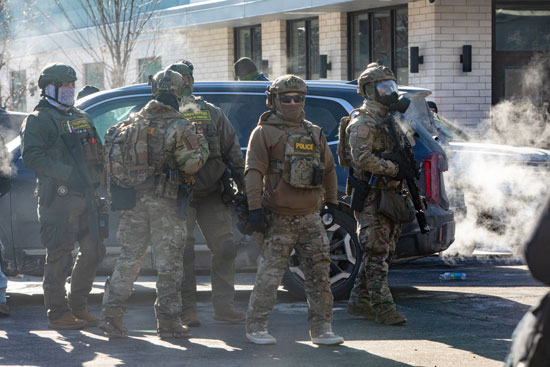
Federal agents gather near the scene of 26th Street and Nicollet Avenue, where federal agents shot and killed Minneapolis resident Alex Pretti Saturday, Jan. 24, 2026
(Photo by Nicole Neri/Minnesota Reformer)

Statistics not provided by federal and local sources courtesy of the Cato Institute and Google Chrome AI searches.


It's Christmas All Over, Again ....
How'd we get from this ... to this?
Both images are of the same jolly old elf, separated by roughly 17 centuries of history. The original St. Nick was Nicholas of Myr, a real live humanoid, a 4th century Catholic bishop and, for a while at least, a genuine saint of the Catholic calendar. He was renowned for his piety, strict adherence to Christian doctrine and secret acts of charity, some miraculous, on behalf of children and the poor. How he morphed from there and then into the secular face of Christmas in the here and now is all revealed on page one of this year's Skelly Family Christmas website. Click here.


 10/1/25 -- "Masters of War"


Pity Donald Trump. He has brokered an end to hostilities with so many warring countries that he can’t always keep their names straight. He now takes credit for ending seven wars since being returned to the White House, in other words in the last nine months. And he’d like some credit for that. Like a Nobel Peace Prize (and perhaps the $1 million cash award that comes with it.)

Actually, the President modestly denies coveting the award for personal reasons, merely asserting that he deserves it. And he’s pretty insistent. He even brought it up in his recent address to the UN General Assembly. (One wonders if he realized that this was one audience with sufficient knowledge of international affairs to put his braggadocio into its proper perspective.)

However, being so obvious in his concupiscence may not be helping his case. Are the Norwegians even listening? The Daily Beast’s Ewan Palmer says probably not. He quotes Asle Toje, deputy leader of the Norwegian Nobel Committee, as saying “influence campaigns” are more likely to have a negative effect than a positive one. “It is hard enough as it is to reach an agreement among ourselves, without having more people trying to influence us,” he complained.

Why does Trump want it so? Nina L Khrushcheva thinks the answer is pretty simple. “US President Donald Trump appears to find it unbearable that Barack Obama has a Nobel Peace Prize and he does not,” she writes for Project Syndicate, an international nonprofit media organization that publishes and syndicates commentary and analysis on a variety of global topics. Khrushcheva is a professor of International Affairs at The New School in New York City and, yes, the granddaughter of former Soviet leader Nikita Khrushchev.

Herewith, a brief catalog of the “wars” the President has "ended":

Armenia and Azerbaijan

These two former Soviet republics have been locked in a conflict for almost four decades over a breakaway region in the Caucasus Mountains that is generally thought of as part of Azerbaijan but has been controlled by Armenian separatists ever since the Soviet Union fell. Trump hosted the leaders of the two countries at the White House in August 2025, where they finalized a peace agreement they had jointly announced some five months earlier.

The President had a little trouble properly identifying the two nations while discussing his peace-making skills later. Armenia’s Prime Minister Nikol Pashinyan and Azerbaijan’s President Ilham Aliyev both praised him for his role in getting the deal signed, but after the ceremony he identified Armenia as Albania and called Azerbaijan “Aberbaijan.”


President Donald Trump signs a trilateral joint declaration with President Ilham Aliyev of Azerbaijan and Prime Minister Nikol Pashinyan of Armenia

While undoubtedly a step forward, the agreement has not been ratified by either country. Several issues remain to be resolved – most notably, Azerbaijan is demanding that Armenia change its constitution – a move that would likely be rejected by Armenian voters in a referendum. Probably by the Albanians too.


India and Pakistan

These two countries have a complex and largely hostile relationship that traces its roots back to a multitude of historical and political events following partition of British India in August 1947. India is Hindu, Pakistan is Muslim, ‘nuff said.

One of their more heated flare-ups occurred recently when India fired missiles across nine sites in Pakistan in response to a massacre of tourists in Indian-administered Kashmir.

Following several days of intense fighting, President Trump unexpectedly popped up and announced on social media that the US had brokered a ceasefire. There are conflicting accounts of how it was negotiated, but Islamabad praised US involvement and, nominated Trump for the Nobel Peace Prize. India's version was that the ceasefire was agreed on directly between the two countries and insisted they’d never even spoken to Trump. For the record, India has fiercely resisted foreign intervention on the issue of Kashmir, over which India and Pakistan have fought several wars, insisting it’s not up to other countries to get involved.


Israel and Iran

Be serious. He bombed them. No peace agreement or a firm deal on the future of Iran’s nuclear program has been reached, and both Iran and Israel have been threatening each other ever since then.


Egypt and Ethiopia

It is unclear how exactly Trump ended this conflict, since, at least according to CNN, Egypt and Ethiopia were not, and are not, actually at war. Not even a little.


Serbia and Kosovo

Another puzzling entry on Trump’s solved conflicts list. There is little recent evidence of a shooting war about to break out between Servia and Kosovo. On June 27, Trump said they were on the verge and that he helped head it off. Kosovo backed up this account, but Serbia denied it had any war plans. “I mean, that was going to be a disaster, and I stopped it,” Trump said in a radio interview on Aug. 19.

Back in his first term, Serbia and Kosovo did sign an economic normalization agreement, on September 4, 2020, at the White House, in the presence of the American President .

Tensions between these two countries also go way back, to the dissolution of communist Yugoslavia in the 1990s and Kosovo’s unilateral proclamation of independence from Serbia, which the latter to this day rejects. It persists in claiming Kosovo as an autonomous province.

This stand-off culminated in the Kosovo War (1998-1999), NATO intervention against Serbia over human rights abuses and Kosovo’s claim of independence, recognized (by everyone but Serbia) in 2008.

Differences and disputes remain, but over the years, there has been increased dialogue between the two countries. Nonetheless, NATO maintains troops there to, in part, “deter renewed hostilities.”


Rwanda and Congo

Once again, Rwanda and the Democratic Republic of Congo are two countries that share a tortured history — tracing back to the 1994 Rwandan genocide.

And they, too, have agreed to various accords over the years, but violence had been increasing since the “M23 rebel paramilitary group” — which the U.N. has identified as receiving support from Rwanda but which Rwanda denies — began seizing Congolese territory in 2022. In January of this year, M23 took control of the Congolese city of Goma.

In this case, though, the Trump administration really did broker a peace deal. Of sorts. On June 27, foreign ministers from Rwanda and Congo signed the U.S.-brokered peace agreement and met at the White House with the President. The deal required both countries to support ongoing negotiations between Congo and M23 and to “support the disengagement, disarmament, and integration of non-state armed groups.” Within weeks, “at least 319 civilians were killed by M23 fighters, aided by members of the Rwanda Defense Force” in the Congolese province of North Kivu, the U.N. reported.


The Nyamata Genocide Memorial: a national memorial and World Heritage Site in Rwanda commemorating the 1994 Rwandan genocide against the Tutsi ethnic group. It is based roughly 30 km (19 mi) south of the capital of Kigali, where thousands of Tutsis were killed. The remains of 50,000 people are buried there. The United Nations has accused Rwanda of wholesale war crimes, including possibly genocide, over the years of conflict in the Democratic Republic of Congo.

Human Rights Watch reported on the same armed campaign, which, it said, happened between July 10 and July 30. FactCheck.org reports that Trump is correct when he says that his administration brokered a peace deal. But they add he goes too far when he says, “You go to Africa, the Congo and Rwanda, they’ve been fighting for 31 years. And I got it settled, all settled. They were all happy, everybody settled. Nobody’s being killed. (Comments made in an interview on Aug. 19.)


Cambodia and Thailand

The 508-mile (817-kilometer) border between Thailand and Cambodia is prone to violent flareups. The most recent round of violence erupted in July when at least 38 people, mostly civilians, were killed and hundreds of thousands were forced to flee their homes.

Cambodia has previously sought a ruling from the UN’s International Court of Justice over disputed areas, but Thailand said it does not recognize the court’s jurisdiction and claims that some areas along the border were never fully demarcated.

First the Malaysian premier and then China tried to intervene, but it was only after U.S. President Donald Trump personally called Thailand's leader that Bangkok agreed to talks. Trump held separate phone calls with the leaders of both countries and was reported to have threatened to stop trade negotiations if they didn’t agree to a ceasefire.

The two sides met in Malaysia within days and so agreed. A peace deal was struck on July 28, but the contested border remains unresolved – even though Cambodia’s Prime Minister Hun Manet said that he nominated the US President for the Nobel Peace Prize.

Much like with clashes earlier in the year, both sides have since made accusations and counter accusations about renewed hostilities on the border. Thai and Cambodian troops exchanged fire and launched grenades in northeastern Thailand less than two months after the deal was agreed to, according to news reports. An increase in tensions over the last few weeks would appear to violate the deal's spirit, although neither side has officially declared the ceasefire void.


Trump may stumble over names and geography on occasion, but, more notably, he also seems to be a little off on the precise level of hostilities or in some cases even whether there were any at all. Some combatants seemed to be doing little more than speaking ill of each other.

Khrushcheva ends up her sentiments on the subject with the following: “Whereas Obama’s Nobel Peace Prize was premature, Trump’s would be parodic. If he somehow managed to browbeat the Nobel Committee into giving him one, the Peace Prize would become a punchline.”

Google AI offers a list of significant new and ongoing conflicts festering around the world. Including some that caught Trump’s eye as well as a couple of notable misses.
Russo-Ukrainian War Entering its third year, Russia continues its offensive, Ukraine faces significant challenges owing to inconsistent U.S. support.
Israel-Palestine Conflict Israel's offensive in Gaza continues, creating a devastating humanitarian crisis.
Sudanese Civil War This internal power struggle between the Sudanese Armed Forces and the paramilitary Rapid Support Forces is entering its third year.
India–Pakistan Conflict A brief armed conflict occurred in May 2025 after India launched missile strikes on Pakistan.
Iran vs. Israel and U.S. Israel launched a sweeping attack on Iranian nuclear and military infrastructure, bolstered by a U.S. aerial bombardment.
Eastern DRC The Democratic Republic of Congo experienced escalated fighting with Ruanda in its Eastern region.
Haiti Gangs continue to control much of Haiti while government tries to restore order amidst an ongoing security crisis.
Ten Conflicts to Watch in 2025, as flagged by the International Crisis Group
  • Syria.
  • Ukraine and European Security.
  • Israel-Palestine.
  • Iran vs. U.S. and Israel.
  • U.S.-Mexico.
  • Myanmar.
  • China-U.S.

Aerial view of war destruction in Beach refugee camp, Gaza Strip.


Quotable

One in three Americans owns a gun; one in four American women will have an abortion. In the 1970s, as partisanship strengthened and polarization worsened, guns and abortion became the defining constitutional issues in the life-and-death, winner-take-all fury of modern American politics. On the left, abortion came to mean freedom and guns murder; on the right, guns came to mean freedom and abortion murder. That none of these equivalencies can withstand scrutiny has not seemed to matter.
Jill Lepore,
Staff writer at The New Yorker and Professor of American History at Harvard University, and of law at Harvard Law School. From her article, "How Originalism Killed the Constitution," in the October issue of The Atlantic, available online but at present only to subscribers. Pity. (posted 9/15/2025)


 9/15/25 -- 'Summer’s Over' Blues?

Treat yourself to a visit to the Summer Song Jukebox and a Re-mem-mem remem-me-mem-ber Then moment (no. 21 by The Earls, 1962). It’s waiting for you there, along with 101 other callow memories of your golden youth. You may grow weary, sad and even old, but your memories never do. Also, the most high-energy live version of Scenes from an Italian Restaurant (no. 69 by Billy Joel, 1977) that this true fan has ever uncovered.
Click here


 7/20/25 -- Deportation Scorecard

"How'm I doin'?" - Former NYC Mayor Ed Koch's patented greeting to passersby encountered on the street.

The President, just like the rest of us, sometimes falls victim to the common presumption that he's winning when actual circumstances would argue something else entirely. After all, he's only human.

For example, just recently President Trump casually referred in passing to our present economy as "the greatest ever." Now if that were really so, whyever would he so desperately want to kill his current Federal Reserve chairman, Jay Powell? (In a manner of speaking, of course.) And consider the present "illegal alien" problem, an issue Trump arguably rode back into the White House in 2024. And which he obviously feels he is presently knocking out the park on a daily basis, however thuggishly. But maybe not. Maybe his feelings are fooling him. Again.

U.S. Immigration and Customs Enforcement, Public domain, via Wikimedia Commons

Now, you may not choose to spend your Sunday mornings with Fareed Zakaria GPS on CNN as he holds forth on international and domestic affairs. You may feel he's too far left on things (even though he isn't), or maybe you're inclined to dismiss CNN as just the flip side of the partisan political pandering on Fox News (even though it isn't), or maybe you are just not keen to slather around in the Washingtonian swamp so early on your day off.

In any case you may not have heard Zakaria say today that Donald Trump and Co. are deporting fewer people per month than Barack Obama did, and just barely more than Joe Biden. What?!

Here's what he said. "Trump signals that his administration is fearlessly executing mass deportations. But the numbers reveal a different reality. Since February, his administration has deported 14,700 people per month on average, according to NBC News. That’s far below Obama’s peak, in 2013 when he was deporting 36,000 per month." And it’s nowhere near Trump's announced goal of deporting 1 million people a year.

Who wrote that report? Obama? Probably not. NBC News insists they got it straight from ICE.

NBC reporting on ICE internal statistics

Separately, NBC News has reported that ICE agents last month arrested the most people in at least five years, but deportations are still lagging far behind. The discrepancy between arrests and deportations highlights the problem the Trump Administration faces in making good on its pledge to deport “millions and millions” of immigrants.

According to ICE data, its agents arrested roughly 30,000 immigrants in June, the most since monthly data was made publicly available (in November 2020.) But the number of immigrants deported in June — around 18,000 — amounted to just a bit more than half the number of arrests, based on internal figures obtained by NBC News.

That discrepancy, NBC said, can be explained at least in part by the number of immigrants being detained who are not immediately eligible for deportation. Immigration lawyers have told NBC News that many of their clients who have been arrested have pending asylum cases and orders from immigration judges temporarily blocking their deportation.

With the large number of arrests and with deportations running at roughly half the same rate, ICE facilities are now being faced with overcrowding. Immigrants in ICE detention centers have complained about hygiene problems, inadequate medical care, lack of food and access to bedding and laundry supplies. ( nbcnews.com, Jul 10, 2025: Trump's immigration enforcement record so far: High arrests, low deportations.)

Zakaria accuses the Trump Administration of prioritizing "optics over outcomes." He asserts that Trump's ICE dragnet is less effective than those of his predecessors because it is "chaotic, theatrical and detached from the systems that work .... What his administration lacks in strategy, it tries to compensate for with spectacle — sweeping up schoolchildren, targeting families, broadcasting raids on social media."

Donald Trump talking a better game than he plays? The man who promised he'd end the Ukraine-Russia war before he even took office? That guy? Imagine that.


 6/21/25 -- "Tomorrow, and Tomorrow, and Tomorrow, Creeps in this Petty Pace ...."


To Donald Trump, "two weeks" is just his way of saying "Manana." And you didn't even know he spoke Spanish.

The President has said he is going to tackle the weighty matter of whether the U.S. should take military action in the Israel-Iran conflict "within two weeks." This is a song we've heard before from him, dating back to the early days of his first term.

He's used it to distract, misdirect, duck questions or just buy time on everything including tariffs, the war in Ukraine, tax legislation, the wall, minimum wage increases, health care reform, Putin's state of mind and multifarious other issues and even with surprises he purports to have in store for us, some defined, some not so much, some not at all. Not a few are never heard of again.

In his first term, possibly his most famous running manana schticks concerned health care. He touted a forthcoming health-care plan on nineteen different occasions in his first term, only to blow past his own deadlines without enacting a plan.

In 2019, Trump declared to Chris Wallace during a June 19th Fox News interview that a health care plan would be unveiled within two weeks: “We’re signing a health care plan within two weeks, a full and complete health care plan that the Supreme Court decision on DACA gave me the right to do.”

Even farther back than that, towards the beginning of his first term, on Feb. 9, 2017 Trump announced to his cabinet that a "phenomenal" tax plan would be announced "over the next two or three weeks." Was it? No. But sometimes dreams and big boasts do come true. His administration did unveil his massive tax overhaul, but it came over two months later. And it was signed into law after Congress passed it in late December. Was this the first time he'd invoked his now-famous time-unit phrase? Possibily, but in all frankness, that was before we had learned to count them.

Just this year, and not too far back, the President teased the nation with a somewhat cryptic promise of something really incredible to be revealed in two weeks. Did it come to pass? No way to know. To this day, nobody seems to know yet what he might even be talking about.

NPR has put down in writing a larger compilation of examples of this favored gambit of his in action if you're thirsty for more. You can read it here.

"And all our yesterdays have lighted fools the way to dusty death."


 5/27/25 -- "If At First You Don't Succeed, Lower Your Expectations."*

*Jonathan Tropper, American screenwriter, novelist, and producer

Where did it go off the tracks? At a campaign rally last November, Candidate Trump was calling Elon Musk a "super genius," a citizen of that same rarified ether where breathe the likes of Warren Buffet, Bill Gates and Bugs Bunny anti-hero Wile E. Coyote. Now, like Wile when he realizes he's overrun the cliff, Musk too is shrinking from view.

He seemed just the kind of huge imago to head up the President's novel concept of a "Department of Government Efficiency." DOGE would be the uber cost-cutter that would offset the cost of extending Trump's 2017 TCJA "tax relief for the rich" program that has pretty much demonstrably proved it was never going to pay for itself as its boosters were guaranteeing back at the time of passage.

A clearly brilliant technologist and the savviest of businessmen, Musk is a CEO and founder of not one but several of the country's most admired (you know, there's nothing in life like a good publicist) technology companies. Whose business career had made him "the richest man in the world." A certified strategist, an acknowledged branding guru, and a cost cutter and pursuer of operational fraud, waste and abuse par excellence. He'd just cleaned up and thoroughly refocused the highly popular but poorly run social network, Twitter, and in jig time, too. He was an unstoppable force in everything from electric car design to space rocketry. Why not government?

There is one regard which might make him an odd choice, or at least one out of character for Donald Trump. Musk was a one-time Barack Obama-backer, who had suggested as late as 2022 that our then ex-president should "hang up his hat & sail into the sunset." In the 2024 GOP primary contest, Musk supported the candidacy of Florida Gov. Ron DeSantis. Such a character quirk is generally fatal in Trump World, but in the presence of such intellect, business success and, well, money, bygones surely could be considered bygones.

Plus, there was this: Musk had offered up more than $250 million of his money to help Mr. Trump, and other GOP candidates win their elections in 2024, (much of it through Musk's America PAC). Trump floated the idea of a Musk-led "government efficiency commission" (DOGE) during the later months of the campaign, an external body that would offer "advice and guidance," in a notably more limited role than the one Musk would assume. DOGE would, in the fullness of time, take on a life of its own, for a little while anyway.

Ahead of Election Day 2024, Elon Musk said he was confident he could uncover ways to cut “at least $2 trillion” from the federal budget if Americans elected the Republican ticket.

I think we can do at least $2 trillion.
Elon Musk at Trump’s Madison Square campaign rally October 2024. “Your money is being wasted, and the Department of Government Efficiency is going to fix that.”

Just two months following the election, however, Musk was already walking that original projection back. He told political strategist Mark Penn in an interview that his $2 trillion figure was actually just a “best-case outcome” and that he thought a more likely outcome would be half of his original goal.

Why? Perhaps because it was quickly becoming clear the DOGE assault had a few things not working for it. A lot of the things Musk and his merry band of "DOGE kids," (software engineers aged between 19 and 24 without prior government experience) were doing were likely in violation of federal law, specifically the constitutionally established separation of powers principles. At least that's what multitudinous lawsuits asserted, from affected groups of federal employees, watchdog organizations like the ACLU, labor unions, advocacy groups and state attorneys general. These are still working their way through the system, but already a number of DOGE actions have been stopped or even reversed as a result of appeals in local and federal courts.

And then, Musk's ruthless and often arbitrary and even uninformed approach toward picking the targets of his Department of Government Efficiency assaults—characterized by the metaphoric spectacle of the Tesla CEO brandishing a chainsaw on stage before a salivating crowd—revolted more moderate public support even as it lubricated the flow of lawsuits, with pushback from federal workers and even Tesla owners and investors.

If Musk was essentially planning to follow the approach he took in reshaping Twitter's workforce and culture, he was going to run into a problem business analysts like to call "scale." Twitter when he took it over was a relatively small and narrowly focused company, with 7,500 employees, most of them working in a fairly narrowly defined field doing very similar things: managing a single social media platform. His strategy in a nutshell was to change the entire corporate mission and culture by literally throwing out the old ones.

But Twitter is a speed boat; the federal government is the entire naval fleet. In fact, the naval fleet is just one part of the federal government. It is vast, with nearly 3 million employees not counting the post office or the armed forces, and they're distributed all over. And the mission is incredibly complex. Our country's operations have a direct impact on the lives of billions of people in the United States and around the world every single day.

And unlike the case with Twitter, Musk didn't buy the federal government. He's just a consultant. CNN notes that within hours of acquiring Twitter, Musk had fired all its top executives; within days, he’d laid off around 3,500 employees, around 50% of the company’s total staff; and ultimately, he dismissed 80% of the workforce. He demanded everyone remaining to forget about working from home and told them if they wanted to stick around they should plan on putting in up to 80 hours a week. That kind of autocratic bull-in-a-china-shop style was never likely to work with the federal government. Either Musk, his people or their enablers—probably all three—had read too much into their mandate. The Federal government is just not constructed to work that way. Being a genius with one doesn't make him a genius with the other.

And anyway, who says what Musk did with Twitter (now rebranded "X") was really pure genius at work? While the labor force and earnings performance have both rebounded somewhat since 2023, the reimagined enterprise is considerably smaller and less successful than previously. The rebranded company literally doesn't try to do as many things as it used to. It can't. It lacks the manpower. That would not be really an option for federal employees. Their terms of employment as well as their work goals and work styles are in many cases dictated by the needs of its publics, the strictures of federal law, as established in legislation passed by Congress. And in some cases strictures made by labor union contracts as well.

A study conducted by Edison Research concludes that X experienced a 30% drop in customer usage from 2023 to 2024. Moreover, it found that only 19% of the U.S. population reported using the platform in 2024, down from 27% in the previous two years. X lost nearly one-fifth of its U.S. daily active user base, with a similar downward trend in the UK and EU. According to analysts, it appears like X will continue its decline in 2025. Emarketer reports that from the time Musk acquired X in 2022 until 2025, they believe X to have lost 7 million monthly active users in the U.S.

The declining user base was compounded by the decline of X's brand and value. According to a recent report from Brand Finance, X's brand is now worth $673 million, a significant drop from the $5.7 billion figure before Musk's takeover. X's revenue fell by 40% when compared to the prior year based on internal company data from June 2024.

I think if we try for two trillion, we’ve got a good shot at getting one.
Elon Musk in an online interview posted on his "X" social network January 8, 2025.

X's revenue is projected to grow in 2025, and the company is improving its financial position. But it is still navigating some challenges, including a substantial debt burden and the ongoing evolution of its business model. X's 2024 revenue is estimated to be around $2.6 billion, which is well below the $5.1 billion Twitter generated in 2021 before Musk's acquisition. (X is a private company now and does not have to release detailed financial reports publicly.)

But perhaps the biggest problem the men (and women) of DOGE faced was that from the start they were precluded from working on total spending, which in 2024 was about $68 trillion. Federal spending is approximately 25% of the total U.S. economy, by the way; but surely you could squeeze a trillion or two out of that.

Here's some rough round figures for you to conjure. Mandatory spending was off the table. That includes Social Security, Medicare, and Medicaid. Changes to those programs would (or at least should) require Congressional action. That would be, at $41 trillion, almost two thirds of all spending. Musk and co. also couldn't touch interest paid on the national debt. That's another 11% of total spending out of their reach at $7 trillion.

The rest is called discretionary spending. Stuff Congress approves on a year-to-year basis. about 26% of total spending or $17.5 trillion. But DOGE couldn't even have at all of that either. Defense spending is in that category, and obviously no one had any mandate for cutting that. Indeed, the President and most of the Republicans in Congress want to increase it. That's another 13% of the total or just shy of $9 trillion.

It bears noting that in 1973, discretionary spending amounted to 9.6% of GDP, with about 60% of that for defense. Today, discretionary spending is 6.6% of GDP. A little under half of that goes to defense (Brookings).

So, for the most part they were kidding themselves all along? Well, yeah. And kidding us too.

I’m excited to announce that we anticipate savings in FY26 from reduction of waste and fraud by $150 billion.
Elon Musk addressing Trump Presidential Cabinet meeting on April 10, 2025. He did not mention the attendant expenses (costs of layoffs, contract cancellations, renegotiations, etc.) of achieving those savings: approximately $135 billion. And, of course, The New York Times and others have questioned their math.

But one thing the once and future President knew was that he couldn't sell the 'ole "it'll pay for itself" line of malarkey this time around. The line its boosters were peddling back in 2017. Hence the need for Musk and his DOGE boys. The actual per annum cost of renewing his cherished (not by him but by the people he promised it to back in 2016) tax deal is about $500 billion. That's the hit Federal tax receipts would take, each year and every year, and that's the number he actually needed Musk to hit. And that is what doesn't look like it's going to happen. (One is inclined to suspect that at least some of the appeal of his tariff machinations is that they'll squeeze additional tax revenues out of an unsuspecting public but it won't be seen as income tax revenues. The Lord giveth and the Lord taketh away.)

For some fun reading from your recent past: "Did billionaires pay off Republicans for passing the Trump tax bill?" (The Center for Public Integrity, February 7, 2019) (Link here.) Be sure to share with your Republican friends.

(Postscript: another kick at the can.) The President's critics (that would be the Democrats, and oh, Rand Paul) worry his 2025 "Big Beautiful Bill," for all its "cost cutting," will only compound the budget woes. Supposedly it would actually add anywhere from $2.5 to $5 trillion to the national debt (over ten years or so: the larger figure from the Congressional Budget Office). Swallowing Musk's meager savings whole. Interest on the debt has more than tripled since 2017.

As for Donald Trump? He couldn't give a fig about the national debt. He'll be gone by the time those numbers show up. Trump's futuristic thinking doesn't extend much beyond the next Nobel Peace Prize award announcement. (Another unrequited desire of Trump's, which if he was counting on capturing by settling the Ukraine War may also, like Wile E. Coyote, be sinking out of view.)

But as to Musk and his Quixotic dreams, in retrospect maybe a super genius was not what was really needed in this situation after all, or maybe it's just that real super geniuses are like cops in a way.

We are like sheep without a shepherd
We don't know how to be alone
So we wander 'round this desert
Wind up following the wrong gods home

But the flock cries out for another
And they keep answering that bell
One more starry-eyed Messiah
Meets a violent farewell

 Don Henley and Stan Lynch, "Learn to Be Still"


 4/5/25 -- "Everything You’re Doing is Bad. I Want You to Know This."* 

*Museum Restoration Director Dr. Janosz Poha to his art restorer in Ghostbusters II .

Whence President Trump’s strange, and long indulged, infatuation with tariffs? It would seem to emanate from his deadly fear of trade deficits. He is obsessed with the notion that if your country has a trade deficit then it is somehow losing wealth and, as he puts it, getting “ripped off” by its trading partners. You could liken this to being scared of the monster under the bed. He doesn’t know what’s under there, but he is convinced that some night it will come out and eat him.

We should be so lucky. One wonders if he harbors the same ill feeling towards his local grocers, who sell him all kind of stuff, and never buy anything back from him. They would no doubt be horrified to learn that he did. They thought everything they did together was an even swap: food for money. If you don’t think you’re getting good value, the best thing to do is shop elsewhere, where maybe they’ll give you more food in exchange for the same or even less money.

Unless of course you’re hung up on quality, which makes balancing the equation a little more complicated. But that is the essence of shopping, is it not? You know: your own personal shot at mastering the “Art of the Deal,” as it were?

But Trump wants to insist that America has been in steep decline, oh say, ever since the 1960s, when he was approaching puberty and when, in his febrile memory, America was a great manufacturing power. Which it was. What he's lost sight of is everything that's happened since.

Fareed Zakaria in a recent Washington Post opinion describes the President's state of mind thusly: https://www.cnn.com/2025/04/06/politics/video/gps0406-tariffs-trump-economy-american-decline

The reality of America as the dominant nation in the fastest-growing and most critical spheres of the global economy today — technology and services — seems to mean nothing to him. His tariffs have been calculated using a method closer to voodoo than economics ... based solely on U.S. trade deficits with countries in goods. That the United States runs huge surpluses in services — exporting software and software services, movies, music, law and banking to the world — somehow doesn’t count. More than 75 %of the U.S. economy is apparently intangible fluff; steel is the real deal.

The notion of imposing tariffs to revitalize manufacturing jobs that have long been outsourced to low-wage countries flies in the face of reason. New factories would take years to plan and build. And when done, they would probably, what with advanced automation, complex computer systems and robotics, require mostly the kind of low-paying jobs that the traditional American laborer long ago moved on from. America has become a land of tight labor markets and well-paid workers.

And besides, who says America gave up manufacturing anyway? Trump?

The U.S. Census Bureau and the U.S. Bureau of Economic Analysis reported that for 2024, the goods and services deficit was $918.4 billion, (up $133.5 billion from $784.9 billion in 2023). This reflected an increase in the goods deficit of $148.5 billion, or 14.0 percent, to $1,211.7 billion and an increase in the services surplus of $14.9 billion, or 5.4 percent, to $293.3 billion. Whew. Lot of numbers.

The U.S. remains the second largest manufacturing nation in the world, behind only China, which with a huge population and low labor costs, still makes a lot of things US manufacturers gave up on years ago, in order to capitalize on their own technological advantages and concentrate on producing things and stuff offering a greater ROI. (Think transportation equipment ($252B), Chemicals ($174B), Computers and Electronic Products ($116B) and non-electric machinery ($109B). Or advanced military aircraft, media and entertainment, aerospace and defense, accounting and legal services, high- end computer systems, computer programming, software development, etc. etc. etc.

In 2018 the Brookings Institute reported that manufacturing constituted 27% of China’s overall national output, and it accounted for 20 percent of the world’s overall manufacturing output. In the United States, manufacturing represented 12% of the nation’s output and 18% of the world’s capacity. In Japan, manufacturing was 19% of the country’s national output and 10% of the world total. Fun fact: overall, China, the United States, and Japan comprise nearly half of the world’s manufacturing output.

The World's Top Manufacturing Countries
Country Share of Global Output
China 31.6%
United States 15.9%
Japan 6.5%
Germany 4.8%
India 2.9%
South Korea 2.7%
Russia 1.8%
Italy 1.8%
Mexico 1.7%
France 1.6%

source: World Population Review (2024 statistics)

Zakaria notes Trump’s nostalgic worldview is rooted even further back than the 1960s. "He looks fondly on the late 19th century, when ... the United States had only tariffs and no income tax, and America was stronger economically than it has ever been compared with the rest of the world. This history is nonsense. In 1900, the United States accounted for about 16% of the global economy by one measure; it is now about 26% of it. Americans’ standards of living and health are much higher today."

In fact, in the last three decades, as Zakaria points out, "the U.S. economy has surged ahead of all its major competitors." Its economy has grown to twice the size of the Euro-zone. U.S. wages are 40% higher. Mississippi, the poorest state in the Union today has a higher per capita GDP than Britain, France or Japan.

Let it also be noted that, contrary to Trump’s stubborn beliefs, the United States is somewhat protectionist itself, with tariff and nontariff trade barriers greater than those of 68 other countries. With Trump's new tariffs, American protectionism will go off the charts, with higher rates than the Smoot-Hawley ones of 1930 that exacerbated the Great Depression.

The Cato Institute recently urged followers to, “Ignore the Politicians: Trade Deficits Don’t Really Matter.” Cato is not some squishy woke leftie pinko think tank. They are libertarian in their policy positions, typically advocating diminished government intervention in domestic, social, and economic policies and decreased military and political intervention worldwide.

“There is no rational economic reason,” Cato says, “why Americans should be expected to sell exactly the same value of goods and services to people in a particular foreign nation that they buy from them.”

For instance, The U.S. is almost always going to run a trade deficit with Canada. We have more buyers: 300 million Americans versus 40 million Canadians. Theirs is a big country (more landmass -- at least paradoxically when you include bodies of water-- than the U.S.) but with a small population. Canada does run trade deficits with countries outside the United States. (Ironically, they just ran an overall trade deficit in February 2025, hardly typical.)

Canada is America’s single largest market by a large margin. We sent nearly US$350 billion in goods and services across Canada’s border in the first three quarters of 2024. Some 34 U.S. states sell more goods to Canada than any other foreign economy. Why would we want to go and tick them off?

In The Wealth of Nations, founding father of modern economics Adam Smith advises, “In every country it always is and must be the interest of the great body of the people to buy whatever they want of those who sell it cheapest. The proposition is so very manifest that it seems ridiculous to take any pains to prove it; nor could it ever have been called in question had not the interested sophistry of merchants and manufacturers confounded the common sense of mankind.”

If there are special situations (with Russia, for example), they are so by virtue of values and priorities outside of economics, such as national security. You might well want to make an exception for weapons of war or militarized computer chips. But for things like automotive engine blocks or high-fashion evening wear or miniature plastic umbrellas for garnishing tropical cocktails, it’s purely caveat emptor. No need to confine their production to the homeland.

Trade deficits or surpluses will always occur and will vary by product and from country to country. But there is little point in paying them much mind. If it still really bothers you, commit to buying less. Most Americans feel like they don't need to resort to that. Because we're richer than everybody else. We can buy what we want.

Should the U.S. be on guard for trade cheats and seek to flush them out, even leaning on them to change their ways? Sure. That would be systematic. But that is not the Trumpian way. His way is to try and blow the whole world up and then rummage through the wreckage to see if there's anything worth salvaging, anything he might want to pick up. A lot of collateral damage that way. The frogs do not die in sport, Donny.

So there, now you have a better overview of the subject than seven out of ten of your closest friends and relatives, and it’s certainly more than your President picked up in his four years at Fordham and U. Penn. And you didn’t even have to do research or write any term papers, but then the odds are good he didn’t either.

Percent of workforce employed in manufacturing, 1970-2011
Region 1970 1980 1990 2000 2007 2011
Developed Countries (U.S., Europe, Japan) 26.8% 23.9% 20.7% 16.9% 14.3% 12.8%
East Asia (China and South Korea) 13.9 22.5 24.3 20.9 21.2 21.5
Southeast Asia (Indonesia, Malaysia, Philippines, Thailand) 11.4 14.4 15.6 16.3 15.4 14.0
India 9.4 9.1 10.5 11.4 11.9 11.6
Latin America 15.5 15.4 15.3 13.2 12.4 11.5
North Africa 12.6 13.8 14.4 14.0 12.9 11.9
Sub-Saharan Africa 5.8 7.2 8.3 8.3 8.6 8.4

source: The Brookings Institution