 |
The Skarry Skelly 2025 Halloween Message |
|
Hey kids, Halloween is here again, if you can afford it. And time for some more of dad's insights on life, if you can stand it. Trick or treat! |
J
ob growth is stalled, inflation is back and creeping steadily higher, the Federal budget deficit is soaring, domestic spending is growing but at a disturbingly slow pace, nobody knows what's going on with Trump's tariffs or whether they're even legal. Business investment and research spending are both kind of on hold, as companies cogitate interest rates, trade policy uncertainty and general economic caution. Congress is AWOL. God only knows what's going to happen with medical costs over the next twelve months, not to mention what the future of vaccines is going to be.
But the stock market? Scaling new heights left, right, center and almost every other day it seems. What's going on? Who the hell cares? Food prices might be plunging you into despair, but apparently it's a great time to be rich. And wealthy holiday consumers show little inclination to pull in their horns for this Halloween. Holiday-related spending is expected to be jumping, just like candy consumption and adult parties. (As you know, Halloween isn't just for kids anymore. Just check out costume sales.) As of late 2023, the wealthiest 1% of earners held more wealth than the entire U.S. middle class. And ironically their enthusiasm may just be contagious. Rising prices or no, a full 73% of American consumers confirm they're in a party mood this Halloween. Not so wealthy? That's what credit cards are for. (Credit card debt reached an all-time high of $1.21 trillion in the second quarter.) Halloween spending should hit an all-time high in 2025: $13.4 billion (with a "$b") according to the National Retail Federation’s annual consumer survey (conducted by Prosper Insights & Analytics). That's up from $11.6 billion last year and the previous $12.2 billion record set in 2023. While there's a certain amount of uncertainty hanging over the economy's long-term growth prospects, the Atlanta Fed's "GDPNow" model was recently "nowcasting" 3.3% annualized growth for the third quarter, matching the second quarter's performance. (First quarter was -.5%.) That would be pretty good considering what's going on, but that could also prove a little optimistic. The Philadelphia Fed's "Third Quarter 2025 Survey of Professional Forecasters" projects a slightly more conservative growth figure of 1.3%. But that's higher than their previous projection. GDP could actually get an ironic boost from Trump's tariffs. Imports are down; see if you can guess why. Import sales are a subtraction in GDP calculations. People could wind up buying more domestically produced stuff and less from overseas markets. But if domestic sales and foreign sales should both turn down, that might send a worrisome message about both our GDP and our future. Right now, though, car sales and housing starts are both on the rise, suggesting fairly robust sustained growth, for now. We'll see. But meantime, whatever happens, your Halloween costume is going to cost more. And don't try to save money by waiting and buying late on sale. Halloween sales started earlier than usual this year. Delay and you could find yourself looking at empty shelves. Dad's advice would be to try and get rich as soon as you can. Or you could, maybe, stop paying your student loans and hope they lose your file. It happens. On the local front, neighborhoods around the Panhandle started decorating for Halloween earlier than usual this year. Usually a good sign for the economy. Oversize (10-15 feet tall) skeletons, zombies, chain saw murderers and grim reapers are a hot new trend here, punctuating lots of front yard displays, making for a positive if disturbingly themed economic indicator. Consumers are expected to spend $1.4 billion this year on costumes for their kiddies, $2 billion(!) more on costumes for themselves and then another $0.86 billion on costumes for their pets.(!!) Have fun tonight, guys. Dress responsibly and try not to scare your signficant other. Also try not to engage in any hate speech, which is defined as any speech the President happens to hate. You could wind up in El Salvadore, where your costume might be misunderstood. Love, Dad |
 websitesammy home page |
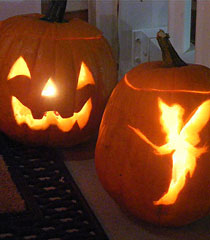
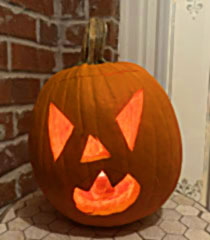
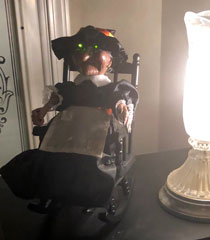
The All Saints’ Day celebration was also called All-Hallows or All-hallowmas (from Middle English Alholowmesse meaning All Saints’ Day) and the night before it, the traditional night of Samhain in the Celtic religion, began to be called All-Hallows Eve and, eventually, Halloween. ("Hallows" is Gaelic for Saints")
The immigrants celebrated as they did in their homelands—which often included pulling pranks. Common Halloween tricks included placing farmers’ wagons and livestock on barn roofs, uprooting vegetables in backyard gardens and tipping over outhouses. By the early 20th century, vandalism, physical assaults and sporadic acts of violence were not uncommon on Halloween.
By the time of the Great Depression in America, violence around Halloween—no doubt exacerbated by dire economic conditions—had reached new highs. Parents, concerned about children running amok on All Hallows' Eve, organized “haunted houses” or “trails” to keep them off the streets.
Around the time neighborhoods began organizing activities to keep kids safe and occupied, costumes became more important (and less abstract and scary). And take the form of characters from popular radio shows, comics and movies. In the '50s, mass-produced box costumes became popular, and trick or treaters began to dress up as princesses, mummies, clowns or more specific characters like Batman and Frankenstein’s monster.
In the mid-1980s, the Coors Brewing Company ran an ad campaign featuring TV horror host Elvira. It helped make the ghoulish night a “beer holiday” in the mold of Super Bowl Sunday and St. Patrick’s Day. Today Americans buy enough Coors beer at Halloween to increase seasonal sales by 10 percent.
Capitalizing on the party mood, retailers began pushing theatrical costume offerings: pin-up pirate, naughty nurse, even sexy Big Bird. Skimpy Halloween get-ups have long been available but in the last decade but now the prevalence of sexy costumes has exploded, according to Lesley Bannatyne, author of “Halloween Nation: Behind the Scenes of America’s Fright Night.”
Why the desire to flaunt so much skin for a celebration that comes around just when temperatures are taking a downward turn? “Whatever box you’re in, Halloween is when you get out of it, and for some, sexiness or outrageousness is their expression of getting out of it,” Bannatyne says.
Sue Mantz is an unhappy pumpkin