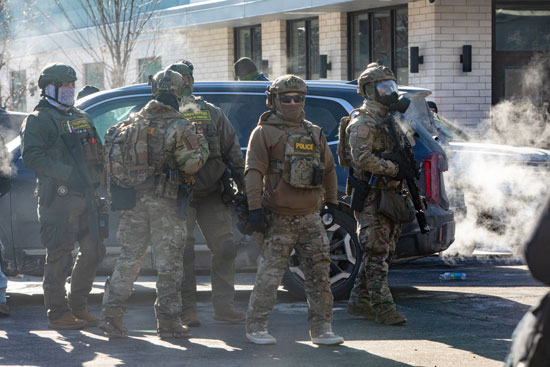
“Violence is as American as cherry pie,” protested civil rights firebrand H. Rap Brown in the long hot summer of 1967, making it clear he was determined to fight for racial equality by any means necessary.
Interestingly, Brown when he spoke those words was director of a civil rights organization called the “Student Nonviolent Coordinating Committee.” (Possibly the high point of his life. Brown would be convicted of murder in 2002 and sentenced to life in prison without parole. He died in custody in 2025 at the age of 82 of multiple myeloma.)
Was Brown’s bellicose plaint truly justified or just brash trash talk from a known hothead? You may be surprised to find that some historians and contemporary observers are today inclined to agree with him. They point to the deep roots of violence in the history of our nation's founding, in its land seizures from Native Americans, in its long embrace of slavery and in the broader racist hostility that endures in some forms right up to the current time. Ask a Muslim. Or a Minnesotan.
And, one might add, in our country’s persistent penchant for going to war. Far more wars than you can count. Some noble, or at least principled: the American Revolution, the Civil War, World Wars I and II. And Desert Storm. Some, like the Spanish American War (started arguably by a couple of newspaper publishers), were PR events. Others cheap initiatives of economic aggression.

Public Domain
Col. Theodore Roosevelt in 1898 with his regiment on Cuba's San Juan Hill, which the "Rough Riders" (the 1st U.S. Volunteer Cavalry), had just captured, along with its sister, Kettle Hill, during the Spanish-American War. The Rough Riders were assembled by Roosevelt and Colonel Leonard Wood specifically for the Spanish-American War. A diverse mix of cowboys, miners, lawmen and college athletes, they were the only volunteer unit to see combat, fighting on foot and not on horseback. San Juan Hill made them famous, but in fact the 10th Cavalry and 24th Infantry fought alongside them, spearheading the charge up the hill and taking the primary role in some of the most fearsome fighting. Called the Buffalo Soldiers, these were experienced African American regiments of the regular U.S. Army. They were commanded by 1st Lt. John "Black Jack" Pershing. The nickname was originally a slur.
Many wars, legit or no, ended in something short of glory and triumph: 1812, Vietnam (and Cambodia and Laos), Afghanistan, Iraq, Korea. But those are the wars you know. Others are barely remembered now, lost in the sands of time and the dustbins of history. Here’s a few you were barely, or never, even aware of.
The Quasi-War (1798–1800): Fought with France, a limited naval conflict with relatively light casualties. The U.S. Navy lost 1 ship to enemy action (later recaptured) and 22 privateers, while capturing or destroying over 100+ French privateers and warships. Approximately 2,000 American merchant vessels were captured by French forces. Casualties: 160 (est.) U.S. personnel killed or wounded, over 100 French casualties.
The Barbary Wars (1801-1805, 1815): Fought to end the North African slave trade and protect U.S. merchant vessels from pirates, a key early foreign conflict. Casualties: American deaths, 50 (est.) Barbary States, (particularly Tripoli and Algiers), 800 (est.) deaths across both conflicts.
The Mexican–American War (1846 -1848): Followed the 1845 American annexation of Texas, which Mexico still considered its territory, (The Republic of Texas was de facto an independent country after its successful revolution against Mexico in 1836.) Mexico was defeated on the battlefield and the war was ended with Treaty of Guadalupe Hidalgo. Mexico recognized the cession of Texas, California, Nevada, and Utah as well as parts of Arizona, Colorado, New Mexico, and Wyoming. The U.S. agreed to pay $15 million for the physical damage of the war and assumed $3.25 million of debt already owed by the Mexican government to U.S. citizens. Mexico accepted the Rio Grande as its northern border with the United States. Counting civilians killed by violence, disease and accident, the Mexican death toll may have reached 25,000. American death toll reached 13,283.
The Boxer Rebellion (1899-1901): As part of an eight-nation alliance, U.S. Marines and soldiers participated in a multinational force in China to suppress a violent anti-foreign and anti-Christian uprising. Casualties: Allied deaths were relatively low compared to Chinese casualties, with several hundred (est.) foreign soldiers and civilians killed. Chinese deaths are estimated in the tens of thousands, with some estimates for total civilian deaths as high as 100,000.
via Wikimedia Commons
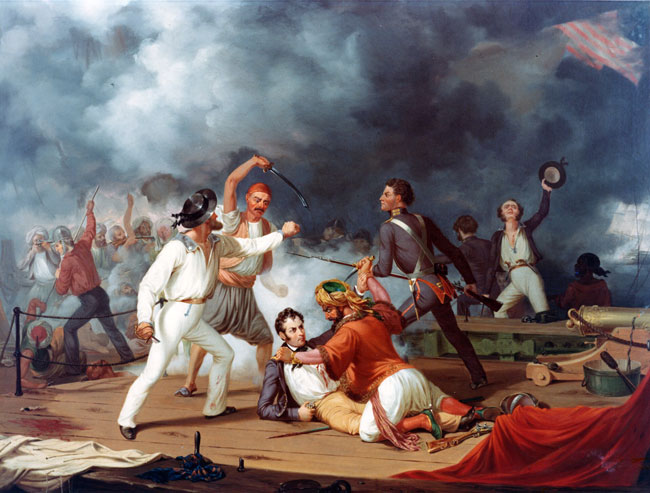
USN Lt. Stephen Decatur Jr fighting hand to hand with the Algerine at Tripoli, aboard a Tripolitan gunboat on August 3, 1804. Decatur boarded the boat after learning that a Tripolitan captain had shot and killed his younger brother, James. As Decatur struggled with the gunboat's captain, a Tripolitan sailor tried to attack him from behind. One of Decatur's sailors stepped forward and took the blow. (He died from the injury.) Decatur was promoted toCaptain at age 25, largely for his bravery in the Tripolitan War. (He remains the youngest Captain in U.S. naval history.) He commanded major vessels during the War of 1812 and became a celebrated American naval hero. Painting in the U.S. Naval Academy Museum Collection.
Texas-Mexico Border Conflicts (1917): A low-level cross-border involving armed raids and intensified violence during the Mexican Revolution's aftermath. Total expedition included 65 Americans killed and approximately 251+ Mexicans killed (169 Conventionists and 82 Constitutionalists).
Major 1917 Conflict Casualties:
• Brite Ranch Raid: Americans: 3 killed (a postman and two passengers on a mail stage). Mexicans: 10 killed (raiders pursued back into Mexico by the Eighth U.S. Cavalry).
• Mexican Expedition Final Clashes: One of the last significant victories occurred at Ojos Azules, where U.S. forces killed 44 Villistas without suffering any American casualties.
• Border Violence & La Matanza: The period saw sustained violence by Texas Rangers, U.S. Army soldiers and vigilantes against residents of Mexican descent. Estimates of deaths from 1915–1919 suggest hundreds or potentially thousands of victims.
The American-Indian Wars (1600s–1920s): A series of conflicts spanning nearly three centuries. In the late 1960s-early ‘70s, a very funny Chicago radio jock, Larry Lujack, broadcast a recurring comedy feature called “Can This Marriage be Saved.” Frequently, he ruled it couldn’t. It’s likely Lujack would have ruled likewise, and very early on, about American Indians and their new friends from Europe. The indigenous people caught on quite early that their invaders were intent not just on possessing all the silver, gold and buffalo, but also the land.
And in a broader sense, you could say their lives as well, through the transmission of European diseases Indians had no natural defenses against. These “wealth transfers” had begun long before the United States were even part of a dream, but the Indians fared no better under Uncle Sam. Which is why so many tribes allied with the British rather than the colonies during the American Revolution. They figured those guys were less likely to stay.
Things only got worse as the colonies started moving west. Manifest Destiny, you know. The new Americans were pretty sure God was on their side. In the 18th and 19th centuries, the Indian nations produced a number of warrior chiefs noted for both their organizational leadership abilities and strategic battle skills. Many of their names are better known to our history books than those of their opposite numbers in the U.S. Cavalry.
Names like Sitting Bull and Crazy Horse, who led the battle at Little Bighorn. Or the Apache Geronimo, grudgingly renowned for his guerrilla warfare tactics. And Tecumseh, the Shawnee leader who organized a massive intertribal confederacy in his fight against the country’s westward expansion. And Red Cloud, (of the Lakota Sioux) who led a campaign (Red Cloud's War) against the U.S. Army, resulting in a treaty favorable to the Sioux. Which made him the first American Indian in the West to "win" a war against the United States. And Chief Joseph, famed for his leadership even in defeat, during the massive retreat of the Wallow Band of Nez Perce, a Native American tribe of the interior Pacific Northwest, in 1877.
And there was Osceola, who led the Seminoles in Florida’s Second Seminole War, who was so popular as a prisoner of war (captured by deception under a flag of truce) while held at Fort Moultrie (SC) that he was generally treated like a celebrity. He was given nearly free range of the Fort’s grounds, he was allowed to receive visitors and did sittings for portrait artist George Catlin. He was even ferried across the Cooper river to Charleston on occasion where he was an honored guest at the theater or social events.
Notable U.S. Cavalry v. Native American Engagements
• The Apache Wars (1851–1900) were Intense, long-running campaigns in the American West stemming from conflicts over (what else?) land and resources. Thousands of lives were lost on both sides of these confrontations. One estimate is that over 5,000 died during the peak of a 12-year period. Casualties included Apache combatants, U.S. soldiers, settlers, and Mexican residents. The conflict led to a major reduction in Apache, particularly Chiricahua, populations through battle losses and disease.
•In the 1862 Battle of Apache Pass, Apache forces claimed 63 warriors were killed by artillery and small arms, while the army reported 9 civilians killed before the fight.
• The Geronimo Campaign (1885-1886): During this phase, 55 civilians were killed, 1 warrior was killed in combat (Ulzana's Raid), and multiple groups surrendered, totaling over 100 soldiers and non-combatants as well. Prisoner Deaths: Between 1894 and 1913, approximately one-quarter of Chiricahua Apache prisoners died from disease, particularly tuberculosis.
• Apache–Mexico Wars in Sonora (1830s): According to one Mexican official, an estimated 5,000 Sonorans lost their lives to Apache hostilities, highlighting the severe, high-casualty nature of conflicts in that region in that era.
These and other conflicts resulted in a huge loss of Apache territory and forced relocation. With Arizona's Yavapai-Apache War, one Facebook post notes that only about 200 Apache and Yavapai Indians survived the conditions at San Carlos to return to their homeland in 1900.
• Little Bighorn (June 25–26, 1876), often referred to as Custer's Last Stand, was a decisive victory for the Lakota Sioux, Northern Cheyenne, and Arapaho tribes over the U.S. Army. The battle ensued out of the U.S. government’s efforts to move Lakota Sioux and Cheyenne onto reservations after gold was discovered in the Black Hills.
The Native Americans saw this action as breaking the 1868 Fort Laramie Treaty and vowed to resist. Approximately 7,000 to 10,000 gathered in Montana, including 1,500 to 3,000 warriors, leading the Army to launch a campaign to force their surrender. Lt. Colonel George Armstrong Custer, who commanded the 7th Cavalry Regiment, pursued with a force of approximately 600 to 700 men including officers, troopers, scouts, and civilians.
The 7th Cavalry suffered 268 killed and 55 wounded in the fight. Custer and all 210 men in his immediate command perished. Native American casualties are uncertain, with estimates ranging from 31 to more than 100 warriors killed.
Seifert Gugler & Co., Public domain, via Wikimedia Commons
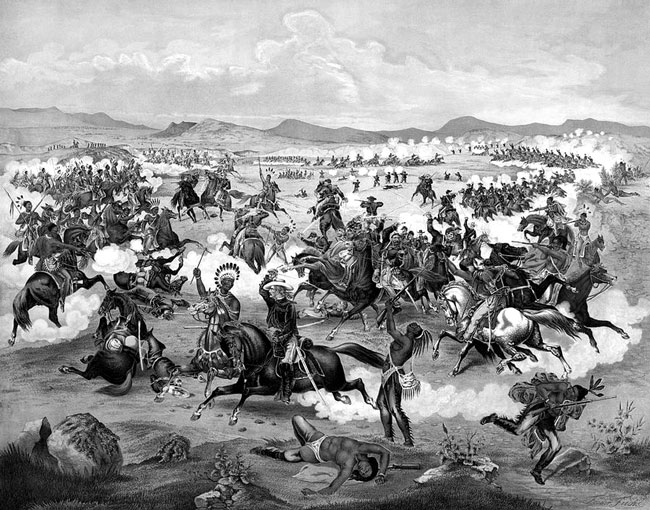
General Custer on horseback with his U. S. Army troops in battle with Native American Lakota Sioux, Crow, Northern, and Cheyenne at Little Bighorn. Custer had grossly misjudged his enemy's strength. Relying on flawed intelligence, he believed he was attacking a smaller, fragmented force rather than a unified army of thousands. He thought the "outnumbered" Lakota and Cheyenne warriors would flee and compounded his mistake by dividing his own forces in order to prevent their escaping his attack.
Total casualties from all of the American Indian Wars are difficult to pinpoint, but some official US government sources estimate roughly 19,000 white men, women, and children and over 30,000 Native Americans were killed in authorized conflicts. Other, broader estimates suggest deaths in the tens of thousands and to hundreds of thousands counting starvation, disease and conflict-related casualties..
The Pig War (1859): A boundary dispute between the United States and Briton over the British–U.S. border in the San Juan Islands (between Vancouver Island (present-day Canada) and the Washington Territory (present-day State of Washington)). It was resolved with little bloodshed. But, Britain? So-called because it was triggered by the shooting of a pig,
The Filipino-American War (1899-1902): A brutal conflict that resulted in over 200,000 civilian deaths. (Most caused by famine and diseases, exacerbated by the war's disruption.) Often referred to as the "Philippine Insurrection," it ignited after the United States annexed the Philippines following the Spanish-American War. What began as a joint effort to expel Spanish colonial rule turned into an all-out war of independence as Filipino nationalists realized the U.S. intended to replace Spain as their colonial masters. Approximately 4,200 to 4,300 U.S. soldiers died as well. Roughly 1,500 killed in action, but the majority succumbed, again, to disease.
Russian Civil War Intervention (1918-1920): Following World War I, the U.S. sent thousands of troops to Russia to support anti-Bolshevik forces, a move that largely disappeared from American memory but significantly influenced early Cold War tensions.
Occupation of Nicaragua (1912-1933): Part of the Banana Wars, when the U.S. military invaded various Latin American countries from 1898 to 1934. The Banana Wars were a series of conflicts that consisted of military occupation, police action, and intervention by the United States in Central America and the Caribbean between the end of the Spanish–American War in 1898 and the inception of the Good Neighbor policy in 1934.
American military interventions in Nicaragua were designed to stop any nation other than the United States of America from building a Nicaraguan Canal. During the occupation, 144 Marines were killed in action and 50 were wounded.
Some 50 years later, in 1983, the Reagan administration engaged in a "covert war" with Nicaragua to destabilize its Marxist-leaning Sandinista government, funding and training Contra rebels, and engaging in economic sabotage and CIA-supervised raids on ports. This was meant to counter Soviet/Cuban influence in Central America, culminating in the mining of harbors and, in October 1983, the invasion of nearby Grenada.
The Iran-Contra affair became a major political scandal during the second term of the Reagan administration. Senior U.S. officials were discovered to be facilitating the sale of weapons to Iran—then under an arms embargo—and using the proceeds to fund the Contra rebels in Nicaragua. The U.S. secretly sold missiles to Iran, often through Israel, with the goal of securing the release of American hostages held by Hezbollah-linked groups in Lebanon. Portions of the profits from the arms sales were diverted to support the anti-Sandinista Contras in Nicaragua. This was by way of bypassing the Boland Amendment, a series of laws passed by Congress that strictly prohibited U.S. government aid to the rebels.
Invasion of Grenada (October 1983): A. U.S.-led invasion of the Caribbean country of Grenada to overthrow a violent Marxist coup that had taken power days earlier. The action was prompted by concerns over the safety of the 600 to 1,000 American medical students resident in the country and fears of Soviet-Cuban expansionism in the Caribbean. Triggered by the execution of Prime Minister Maurice Bishop, the U.S. intervened to restore order and eliminate leftist influence.
The Reagan administration viewed the new military regime as an extension of Cuban and Soviet influence and sought to prevent the island from becoming a strategic staging point. Casualties: 19 U.S. service members killed and 116 wounded, approximately 24-25 Cuban forces killed and 59 wounded, 45 Grenadian forces killed and 358 injured. Additionally, 24 Grenadian civilians were killed, mostly during an attack on a mental hospital. The main combat phase of “Operation Urgent Fury,” which began on October 25, was largely completed by November 2. Some U.S. forces remained for security and stability operations, with the final combat units departing on December 15.
Whew. That’s enough of breast-beating over ancient and mostly forgotten squabbles. You can’t just go on with your life living in the past. Time to go in and catch up with what’s on the evening news.




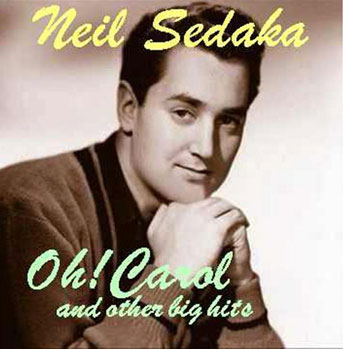 The embodiment of a strong argument for an enlightened immigration policy, Neil Sedaka died February 27 at age 85. He was born in Brooklyn on March 13, 1939. His father was a taxi driver, a Lebanese Jew who came to the United States by way of Turkey; his mother was of Russian and Polish descent. It can safely be said he grew up to become a legendary American singer and songwriter (as well as a classically trained pianist) whose influence on American pop music has been profound and lengthy. It endured over eight decades. Sedaka was one of the first teen pop sensations of the 50’s, a tunesmith on his own behalf and many others' in the 60’s, an international superstar in the 70's. He got both his high school and college degrees at the Juilliard School of Music. When he was 16, a group of renowned pianists including Arthur Rubinstein named Neil Sedaka one of the best high school pianists in New York. Sedaka and his neighbor and writing partner Howard Greenfield signed with Don Kirshner and Al Nevins, making them two of the earliest employees at Aldon Music at the high cathedral of the 50s pop world, the Brill Building. Aldon would go on to sign Neil Diamond, Carole King, and Paul Simon among others. Sedaka was 19 when he and Greenfield wrote "Stupid Cupid" an early hit for Connie Francis, released in the summer of 1958. They also wrote “Where the Boys Are,” the theme for her 1960 eponymous Hollywood movie. His own major hits in this period included "Breaking Up Is Hard to Do" (1962), "Calendar Girl" (1961), "Oh! Carol" (1959: inspired by Carol King whom he briefly dated and remained lifelong friends with), "Happy Birthday, Sweet Sixteen" (1961), "Stairway to Heaven" (1960: not the Led Zeppelin one) and "Next Door to an Angel" (1962). His star faded a bit with the British Invasion, but he wasn't done, His popularity was undimmed overseas, owing largely to his having recorded versions of his hits in Italian, Yiddish, Hebrew, Spanish, French, German and Japanese. He recovered his stateside mojo with the help of Elton John, a longtime admirer who put him under contract with his Rocket label after they met at a party in 1973. Sedaka's second act included "Laughter in the Rain" (1974), "Bad Blood" (1975, with Elton John on backing vocals), "The Hungry Years" (1975), "Love Will Keep Us Together" (1975, Captain & Tennille), "Solitaire" (The Carpenters, 1975, and Elvis Presley, 1976). He recorded his last big hit in 1975,