|
|
| 10/12/05 - The Road East |
|
Leaving California proved a tough slog. It had rained the day we moved in, on March 1, 1997, and driving out we got rain and thunder and lightening going through San Bernadino. That first night we got only as far as Barstow. And not everything got that far. West of San Bernadino the roof rack blew off the car, taking with it JJ’s two guitars, his snowboarding equipment and my luggage
It happened one mile before the Haven St. exit on the 210 West. It appears the clasps just gave way. We had just reached up to make sure it was secure because I thought it was flapping a little loud. It felt solid and steady. I'd checked it at the gas station 10 min. before, and it looked fine there too. But then sproing! We felt again and it was gone.
We got off at the next exit, called 911, and they said they'd dispatch an officer to see what could be retrieved. Then we swung back around and drove back to the previous exit to see what we could see. It seemed we might have a chance because we'd been in the carpool lane and there'd been no one directly behind us. I found the site, even in the dark, more easily than I thought I would. It looked like there was some stuff on the side intact. So I pulled off to wait for the officer.
I concluded there wasn’t much hope for the guitars, and then I saw the canvas guitar bag for the electric being pushed up in front of us by the traffic, a few feet at a time every time something ran over it. It was all trucks and all high speed, and the bag just flapped along every time it got hit. The bag was empty. The electric guitar that had been in it was obviously no more. There was other unidentifable debris floating along as well, maybe mine maybe not.
We waited on the side for about 10 min., which was unnerving in itself. Every time a truck passed in the inside lane the car shook. There was no thought to getting out. Which seemed to be the only thing the dispatcher was concerned about. I called her back, and she explained my timing had been bad. It was shift change, and there wouldn't be an officer available for another twenty minutes. I told her we'd move on. By that time, anything that had been on my roof rack would have been reduced to sand by the trucks.
June pointed out my pair of maroon and gray striped boxer shorts in the road, and then as we were pulling away, I saw, apparently intact in the center lane, my yellow and orange bathing suit moving steadily east with the traffic. Every Father's Day Sarah would buy me a new bathing suit in the loudest colors she could find. She wasn’t home this year, so that one was from two years ago. No way to retrieve it.
We drove another 50 miles or so to Barstow, by which time it was 11 pm, and stopped for the night, feeling pretty low. We hadn't gotten away from the house til almost 8 pm. We'd just wanted to get a few miles from home. I wouldn’t have bothered with the roof rack, but I'd wanted to present JJ with his guitars when we reached Columbia. He'd been so depressed without them.
The rest of the trip got progressively better. How could it not? I bought a new wardrobe in the Barstow Wal-Mart the next morning, a pair of jeans and a blue t-shirt., and we bought a portable aerator for the fish in a local pet shop from a very helpful man.
The fish was dead when we woke up in Flagstaff next morning, floating on his side, motionless, on top of the water. We had turned the aerator off for the night because it was noisy and to give it a rest. That probably wasn’t a good idea, but June brought him back. She has a nice touch. She quick threw him in a small travel tank and turned the aerator on directly in his face. He gradually resumed his swimming, unaware of, or unwilling to talk about, seeing the face of God. That day we went to see cliff dwellings in Walnut Creek AZ, just outside of Flagstaff, where Indians had lived and died 800 years ago.
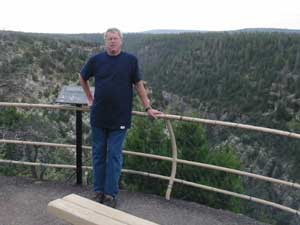
John and his new clothes posed against the 7,000 ft.-high cliffs of Walnut Canyon whose carved out caves in the canyon wall were home to the Sinagua some 800 years ago. From here they apparently moved to Manhatten.
We didn’t do a lot of other sightseeing, although in Shamrock, TX, we stayed in the same motel Sarah and I had stayed at in January of 2000 when we drove her car to Chicago so she could have it at school. June and I also ate in the same restaurant, too, the Lonestar Roadhouse, arriving, as Sarah and I had done, after closing but they let us in and served us anyway. Very hospitable people, those Texans. This time I bought a souvenir t-shirt. I needed a change of clothes anyway.
For the statistically inclined:
| Date |
From |
To |
Mi. |
Hrs. |
| Mon-9/19 |
Tho. Oaks |
Barstow CA |
167 |
3:00 |
| Tue-9/20 |
Barstow |
Flagstaff AZ |
358 |
6.45 |
| Wed-9/21 |
Flagstaff |
Santa Fe NM |
394 |
8:30 |
| Thu-9/22 |
Santa Fe |
Shamrock TX |
414 |
6:45 |
| Fri-9/23 |
Shamrock |
Little Rock AR |
509 |
8:45 |
| Sat-9/24 |
Little Rock |
Anniston AL |
491 |
10:00 |
| Sun-9/25 |
Anniston |
Charleston |
438 |
9:30 |
|
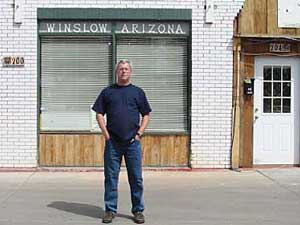
John wanted to buy a t-shirt in Winslow that said just that: "Winslow." Cannot be done. They all say, "Standin' on a corner," etc, and feature a photo of the corner in the bargain. Thought of trying the local high school, but the guy at the souvenir shop said he'd been trying to buy a hat from them for two years. No girls or flatbed Fords either. No wonder movies are so expensive.
We stopped at the Clinton Library in Little Rock, just to piss off Mike Radin, but we snapped a picture he’ll like, a display put up by a fellow republican, although one perhaps more in his dotage than even your average republican.
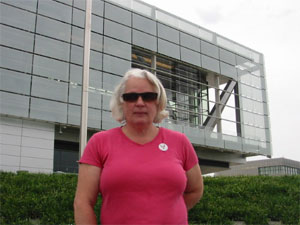
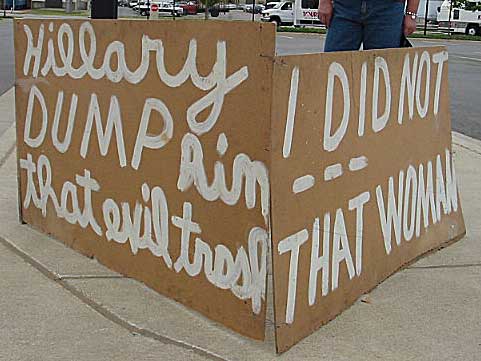
June outside the Clinton Library in Little Rock. Not everyone there was a fan.
Then we crossed the Mississippi river and drove around Memphis a bit. We went by Beale St. (You can’t drive down it; it’s closed to vehicular traffic.) And no, we didn’t follow the ghost of Elvis up to the gates of Graceland, but we saw Sun Records and stopped in at the Gibson Guitar Factory, where prices were way out of my league.
In time, the cat and the dog got to the point where they freely roamed the car -- without once getting under my feet. The dog spent most of his time sleeping in June’s lap, his idea of heaven. The cat’s best moment was sitting on top of the cage during one of those rare spells when Dutch, rather than he, was inside it. (A time out for Dutchie.) He could look down on the dog though the mesh top.
About 80 mi. outside of Birmingham, the highway disappeared and we hit the requisite patch of black, winding, twisting back-country two-lane road in a rainstorm that reminded me my California windshield wipers were overdue for changing. Just outside of Birmingham, I got pulled over by a sheriff’s deputy for failing to dim my high beams fast enough as I approached him. He let me go with a warning. Guess he wanted to look inside a car driving on a dark night on an unlit road in rural Alabama sporting California plates.
We spent that night on the Georgia border as the only guests in a hotel block with a bathroom we had to share with cockroaches. June trapped the biggest one under a styrofoam cup and left him there for the duration of our stay. I had to plug the lamps into the wall sockets before I could turn them on. The lobby was locked, and the desk clerk worked behind a grill. We brought dinner in from an Applebee’s across the street. It was late, and this had been our longest drive of the trip, ending almost as late as our first, star-crossed night out. But we slept okay.
The next day was Sunday. We got an early start and were across the line into Georgia in no time. We got some rain going through Atlanta, but nothing serious and clear skies after that. After a brief stop in Columbia to see JJ, where we did not reveal the truth, we reached the holy city of Charleston around 6:30 that evening, and crossed over the Cooper River into Mt. Pleasant where Sarah and Tracey and the other cat were waiting for us in a hotel that didn’t accept pets.
Tracey had flown to Sarah’s place in Tampa—the original plan had been for her to take both cats but the airline double crossed us and would only take one. Then the following weekend, they drove up to Charleston. They’d moved out of their first motel because their room had cockroaches.
We snuck everyone in our first night and then moved to a more accommodating place across the street the next morning. The petless hotel was lovely, but having Dutch on the fifth floor was no picnic anyway. He had stopped going to the bathroom around New Mexico, but one couldn’t afford to take chances, and actually that meant taking him our more, rather than less, frequently and returning to the room without the usual confidence that the dog would be done for a while.
I told June back in Barstow before the fish died I figured that on a trip like this things ought to balance out eventually. Looking back, I’m left with a certain feeling of accomplishment tinged even with some pleasant memories. But if things were really going to balance out, I think by the time we crossed the Mississippi I should have struck it rich, and that didn’t happen. I’m still waiting, however, trying to be patient.
|
|
6/21/05 - Summer Solstice |
Well, I'm goin' out west where I belong
Where the days are short and the nights are long
Where they walk and I'll walk
They twist and I'll twist
They shimmy and I'll shimmy
They fly and I'll fly
Well they're out there a'havin' fun
In that warm California sun.
("California Sun": Henry Glover and Morris Levy, 1964)
Yesterday was the longest day of the year. And up above is what it looked like as the sun slipped down past the mountains and into the Pacific.
Actually, So. Cal.'s longest day of the year is shorter than New York's because it's so far south. |
On June 21 in Los Angeles, the sun rose at 5:43am, and it set at 8:08pm. In New York, it rose at 5:20am and set at 8:30pm—an extra 34 minutes of daylight. LA makes it up in the winter, when the sun moves south and the situation reverses itself.
Below, you can view a chart of sunset times on the east and west coasts throughout the year. So the song is right, at least in the summer. The days are shorter, the nights are longer.
I have a lot of time on my hands.
|
|
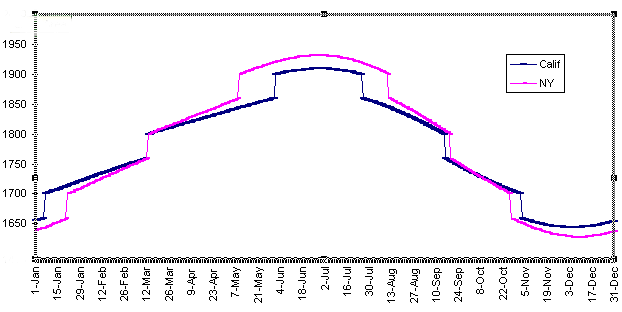
(Daylight Savings Time not reflected.) |
6/11/05 - Prom Night in Westlake |
Click the links below the picture at right for photos from the Wessels' paparazzi event preceding the humvee limo ride to Westlake High School's 2005 night of magic and enchantment.
Ah, house is sure quiet. If you have photos you'd like to add to this lovefest, email me and I'll tell you how.
Enjoy. |
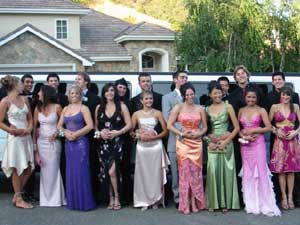
http://www.pbase.com/jjskels/prom_nite_05
Wessels' Photos |
|
4/1/05 - Spring Has Sprung |
|
This year, everybody in California is talking about the weather; June and I decided to do something about it. The Friday after Easter, we drove out to the desert to look at things in bloom.
This is a very good year for California's deserts. All that rain that's been making people miserable—36 inches in LA since July 4, the second wettest year on record—has turned the desert landscape into a riot of color, relatively speaking.
The fact is, the desert is still basically brown, as June rightly points out. But there are a lot more flecks—yellow, purple, white, red, etc.—in it now. Small flecks but millions of them.
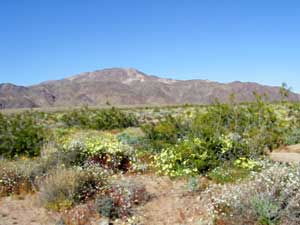
Typical annual rainfall here rarely exceeds four inches. More than that fell in January alone this year. Some ecologists are saying this is the best wildflower bloom in 100 years.
With the wildflower bloom, tourism at California's desert-focused national parks is blossoming as well. Death Valley, (3.3 million acres) recorded 14,000 visitors on a recent day at its park headquarters versus the 4,000 that is normal for this time of year. (Summer is not the time to visit Death Valley anyway.) See Los Angles Times, March 31, 2005, Lush With Flowers, Lousy With Tourists
We headed out to Joshua Tree, about 150 miles east of Los Angeles and much closer to home. It's a much smaller park (789,745 acres), but actually it gets more annual visitors than Death Valley—over a million a year, primarilly campers, daytrippers and rockclimbers. Most of the license plates we spotted were from California.
Joshua Tree became a national monument in 1936 and was elevated to national park status in 1994. Two separate ecosystems, whose characteristics are determined primarily by elevation, come together at the park. The higher, moister and slightly cooler Mojave Desert is the special habitat of the Joshua tree.
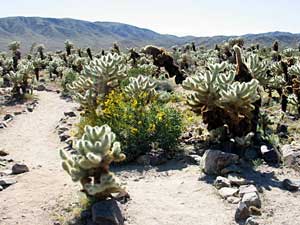
Below 3,000 feet, the Colorado Desert encompasses the eastern part of the park and features natural gardens of creosote bush, ocotillo, and cholla cactus. And by our reckoning, a far greater abundance of wildflowers, which did not disappoint.
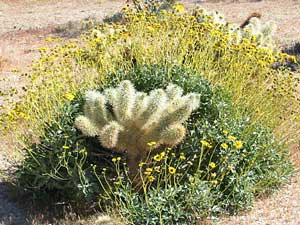
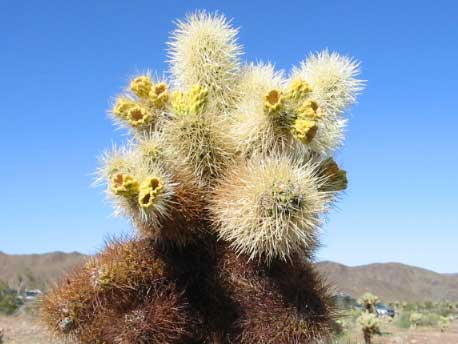
The Cholla (rhymes with "Goya") cactus appears to be covered with soft, silvery bristles, but in fact its spines are tipped with microscopic barbs that drive deep into the skin at the slightest contact.
|
>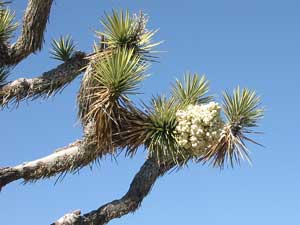
The eponymous Joshua tree can reach up to forty feet in height, but it has to contend with extreme aridity and rocky soil. It got its name from the Mormons in the 1850s. They saw the craggy branches of the trees as the arms of Joshua leading them to the promised land.
Throughout the park, one encounters great heaps of boulders, pushed up by the Pinto Mountain fault. Their edges have been rounded and smoothed by centuries of flash floods and winds. The western part of the park includes some of the most interesting geologic displays found in California’s deserts.
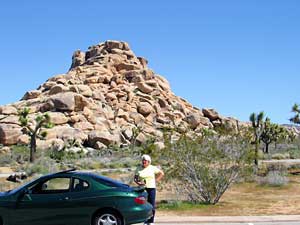
Large sections of the park look like God's rock quarry. Broad heaps of giant loose rocks tossed haphazardly about—like one assumes Afghanistan looks like, or even parts of Eastern Kentucky after the mountaintop mining operators have moved on.
The area was originally inhabited by the Pinto Indian Culture, followed by the Serrano, the Chemehuevi and the Cahuilla. In the 1800s cattlemen grazed their cattle in ample grass available at the time and built water impoundments.
About 300 gold mines were developed in what is now Joshua Tree National Park—although few were good producers. An exception is the Lost Horse Mine, which produced 10,000 ounces of gold and 16,000 ounces of silver (worth about $5 million today) between 1894 and 1931.
Homesteaders began filing claims in the 1900s. They built cabins, dug wells and planted crops on land where the daytime summer temperature routinely reaches 1150F. But they're all gone now, too.
Cool, huh? I'm not sure God wanted anyone to actually live in this state. I think He just wanted them to see it.
 |
|
1/16/05 - Yeah, But We Got the Weather |
|
In The Princess Bride, Inigo (Mandy Patinkin) says to Vizzini (Wallace Shawn), "You keep using that word [inconceivable]. I do not think it means what you think it means."
Here in Southern California, we're inclined to deflect the many criticisms directed our way by saying, "Yeah, but we got the weather." And it's true enough, but I don't think it means what we think it means.
We are indeed blessed with a norm of cloudless blue skies and agreeable temperatures. This seduces many Californians, who as a general rule are not the most reflective of people, into uttering mindless meteorological banalities. (That and a lack of other defenses.) JJ's baseball coach once offered him that response when JJ said he missed his friends in New Jersey. Offered it in the middle of the El Nino storms of 1998 that were washing away hillsides and roadways.
When Californians talk about the weather, they display a collective amnesia that glosses over some of the roughest patches of weather you will encounter anywhere in the country.
It doesn't get freezing cold and ridiculously snowy (except in the mountains, but that's good for snowboarding right?). What winter does bring is howling winds, called Santa Anas, that blow for days at a time. They start as soon as I put the big red bow on my outside wreath. I then have to retrieve the bow from my neighbor's yard.
The wind also knocks over so many trucks on the highways that they have to close the roads through certain passes until it dies down. A couple of years ago, a tennis player in Simi Valley was killed when the wind blew a tree onto his court.
Unless you live right along the water, say in Santa Monica in a $2 million three-bedroom, summer often means triple digit thermometer readings in an area where, for some reason, even 80o of this baking heat feels like a 100o does in Iowa or Pennsylvania. By early fall, the air is so dry we get raging brush fires (also wind-aided) from the slightest spark.
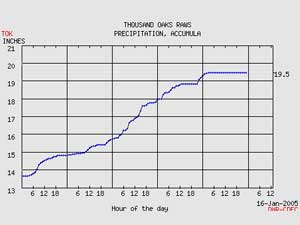
And when it rains! The song is correct. This area receives just 14 inches a year on average, but it falls over about seven days. Then there are the wetter than average years. Like this one. As of Jan 10, we'd gotten 16 inches of rain since Christmas. The ground can absorb only so much, and then it starts to move. Generally downhill and in a hurry. |
The result is something like La Conchita, although that was an extreme result even for this place. In all, ten people lost their lives, and 13 homes were swallowed by a wall of mud when a hillside above the neighborhood collapsed. A mudslide ravaged just about the same spot ten years ago, but people grow attached to an area and are loath to move away.
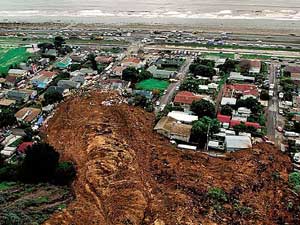
Click for mudslide video. Courtesy of YouTube.
One good thing, very few flying insects here, including mosquitoes. But more ants than you've ever imagined in your life. And they come into your house at two times: when it's hot and dry and when it's cold and wet. And they get into everything. When they're visiting, no food of any kind can be left out on any counter, no candy in any drawer, not even last year's candy canes wrapped in plastic and stored in a box in the closet. Glasses, plates and silverware have to be washed twice a day. They even like toothpaste. You kill millions at a time and they just keep coming. George Bush really wouldn't like California. Talk about your insurgencies.
But the sun finally came out today, and lo and behold, the mountains out our family room windows are capped with snow. A beautiful sight. A little cold, but it's supposed to warm up by the weekend. Sigh, when it's good, you really can't beat the weather.
Note: Earthquakes are not meteorological events.
|
|
11/11/2004 - Playing at War in the Conejo |
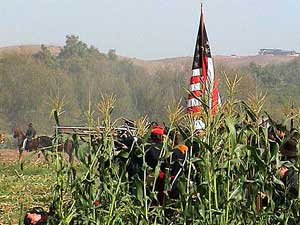
Lee took on Grant for the very first time, again, over the weekend, in the Battle of the Wilderness (Day One). It was a reenactment for our viewing pleasure at a nearby farm off Tierra Rejada Road, just below the Reagan Library. It was about four miles up the road from where we live and where we go for corn and tomatoes in the summer.
The original battle raged May 5-7, 1864, not far from Spotsylvania Court House, VA, in a heavy thicket choked with dense underbrush—hence the name. Ours took place in a cornfield ringed, judging by the aroma, with arugula. How California. (Arugula, while it may be grown hereabouts, is hard to come by locally in quantity. Most stores sell it only in those little, plastic, overpriced packets. Tough way to make a salad.)
Reports from the original Battle of the Wilderness had it that what with the brush and trees and the smoke from the all the rifle fire, you couldn't even find the enemy until you were right on top of him. Our view was pretty good from just about anywhere along the perimeter. There were close to a thousand spectators, I would estimate. I don’t know how many participants, probably several hundred.
About 200,000 troops took the field in the original fight, and there were about 20,000 casualties. (Always a mystery to me about Civil War battles: casualties included dead and wounded all lumped together. It’s always seemed to me it would make a great deal of difference whether you were in one group or the other. It would have to me.)
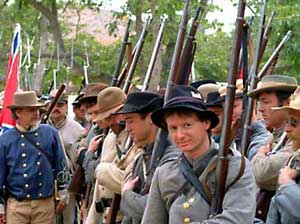
The Union had twice as many losses as the Confederates. Which is basically the way Grant won the war: He had more men to loose and he was willing to lose them if that’s what it took to grind down the opposition.
One story has it that on the night before the battle, Union Gen. Winfield S. Hancock's Second Corps was bivouaced on the site of the Chancellorsville campaign, which had taken place the year before (technically a Confederate victory but where Stonewall Jackson was mortally wounded by his own troups—a case of "friendly fire"). Skeletons, uncovered by the winter rains, littered the camping area. An infantryman kicked at one of the skulls, and told his comrades: "This is what you are all coming to, and some of you will start toward it tomorrow."
There were only intermittent losses at our site, carefully staged for dramatic punctuation as it were. In truth, the battle itself wasn’t all that interesting. It went on too long and not much seemed to be happening that made any sense to the spectator. It might have had a different feel if you were in the middle of it, something that could probably be said about any war.
The interesting part of the day was the scene itself and its ambiance. Full camps of tents on each side, with more tents of camp followers as well, although these were selling souvenir wares rather than personal services. Still, the idea remained the same: trying to turn a profit from the moment.
Most compelling were the long lines of soldiers queuing up for the battle. The drilling, the interminably long and apparently pointless waiting, the humorously bad communications and false starts (and many of these guys carried cell phones) called to mind many a story received about military life from friends who’d been soldiers.
The pecking order was something to observe. The participants were into the spirit of this thing all day long. They saluted their betters to a fare-thee-well. And spoke solicitously and at length to their equals. Some of them even affected southern accents. There were clear signs of the virtue of socio-economic advantage. If appearances were anything, it was good to have some money: you got a better uniform—which invariably came with a higher rank. And it certainly paid to have a horse.
At one point, two men in a collection of infantrymen waiting to be moved to the battlefield could be heard talking about the fight that was getting ready to start in Fallujah. The one soldier was saying that the talk about US troops invading hospitals and harming its occupants were unfair and distorted. Who do you think is in those hospitals?” he exclaimed. “Why it’s all terrorists and Al Qaeda!”
|
Their conversation was cut short when the order came to move out. Then came the best part of the day: watching the lines of foot soldiers, the cavalry riders and the caissons move past the picnic area where June and I were sitting sipping a couple of beers despite the early hour. Very realistic.
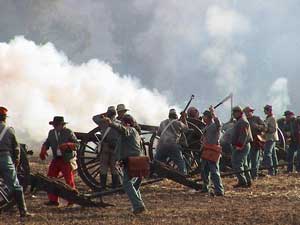
For the first time, I understood the importance of drill practice. That was something I never saw the point of. Wasn’t it something just about anyone could do instinctively? It turns out there’s some skill and organization involved in getting several hundred men, not to mention horses and wagons, from point A to point B without having one bunch march up the backs of another. If you don’t say “halt” and the next guy doesn’t say “halt” and the next and the next, all in timely fashion, and if the squads don’t respond in equally timely fashion, why, someone gets trampled and you have a mess on your hands. I saw minor catastrophe narrowly averted more than once this day.
There were a number of caissons led by six-horse teams, one rider astride a horse in each row and not just up there to look good. Those guys worked hard turning their rigs, running their teams wide and then curling back into the turn, just like a tractor-trailer negotiating a narrow intersection—only with six separate engines! You certainly don’t want a set of caissons marching up your backside. Those guys knew how to keep their distance, and in turn everyone else kept their distance from them, fore and aft. The war might be play, but that danger was real, as innocuous as the exercise might appear to the casual onlooker.
Throughout the day, on a stage off to one side of the cornfield, a steady stream of politician impersonators—Sheridan, Lincoln, Lee, Longstreet, Davis—took turns arguing the merits of the war and what it would mean to our future. People paid polite attention for a while and then wandered off. After all, it wasn’t the main event.
But something I heard Lee say struck me. He said, “I never coveted any territory in the North, I wasn’t trying to dictate how anyone should live, I never raised arms against anyone until Virginia was invaded. I was only defending my home.” I couldn’t wish any other outcome to the Civil War than the one eventually achieved, but I’d never thought about it quite that way before.
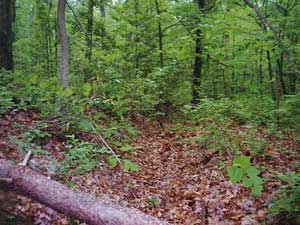 A recent picture of the real Wilderness
About three-quarters of the way through the battle, June and I decided we’d seen enough of war and began to make our way back through the camps to our car. We went once more through the sales tents to browse a little among at the items on sale, but we left empty-handed.
That night, they were having a buffet supper and dance for combatants on both sides and anyone else who cared to stay, but we were tired and evening was still a long way off. I suggested that maybe they should have tried that during the Civil War, it might have shortened hostilities. June said she was pretty sure they had, but it wasn’t nearly enough.
Civil War re-enactments foster tourism
Battlefield visits on the rise
Friday, November 12, 2004
RICHMOND, Virginia (AP) -- From Spotsylvania to Shiloh, Civil War enthusiasts continue to re-enact clashes from the conflict fought nearly 150 years ago, traveling to battlefields with their weapons, uniforms and passion for history.
Now instead of just allowing re-enactors places to stage their skirmishes, local and state officials are starting to underwrite the events, recognizing that their investment can pay big dividends.
"In one word, it's tourism," said Jim Campi, policy director for the Civil War Preservation Trust. "It's taken awhile but local and state officials have come to realize that Civil War battlefields and battlefield preservation can mean big bucks for their community."
|
complete story
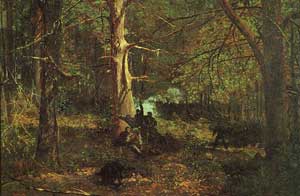
"A Skirmish in the Wilderness," Winslow Homer
|
|
|
|
7/16/2004 - Hey kids, what time is it? (click) what time is it? (click) what time is it? (click) .... |
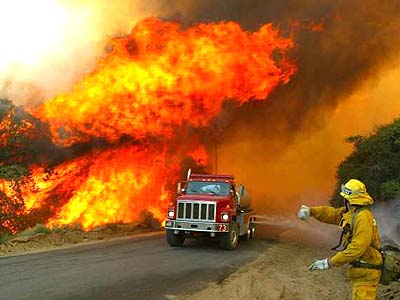
August is the cruelest month burning generally, but it appears this year we're off to an early start. Ah, the fire season: the thing that puts the gold in the Golden State, not to mention the black in the skies, the specks of white ash on your cars, the red and yellow and even lime fire engines all over your highways and byways. Lord, it's a sight to stir the blood. And scare the piss out of the young ones. No wonder so few who live here were born here. They get the hell out.
Many young readers will apparently not understand the headline to this story. They won't know what a record player is, much less that it skips. The phrase "like a broken record" means nothing to them. That's one of the revelations of an email that regularly makes the rounds of college administrators concerning the current crop of incoming freshmen and what they know and don't know and why they're very different from you and me. (See below.) Courtesy of a friend who works at a college in Binghamton, NY.
JJ is visiting colleges next month in Massachussets, North Carolina and South Carolina. He's looking at several in California as well, but the prevailing winds appear to be easterly. The colleges here are very hard to get into and offer an impersonal, some would say spiritless, experience, which somehow seems right for this place. His mother is accompanying him east. On the visits only -- at least, so far.
|
JJ's got a job this summer, working in a trendy kids' clothing store and putting in lots of hours. Last week, he made more money than I did. Although his mother points out that's not so hard to do.
Tracey continues to work in the doctor's office, filing patients away or at least their medical records. Sarah's not working, not for pay at any rate. She's taking Cellular Biology and Organic Chemistry at Cal State Northridge so she can graduate on time (in a manner of speaking) and proving that if she takes them one at a time (two five-week semesters) she can kick their arses alright. I open up the computer lab at the adult school a couple of mornings a week, and talk about html even if no one wants to listen. And the rest of the time spend hours in the pool floating on my back and looking up at the blue, cloudless patch that sits above my house like a movie prop, and watching the airplanes from the Orient head down to LAX, and making sure they don't fall.
So the time peels away, and on I move into the deep, languid summer where the days blend seemlessly one into the next until it's no longer possible to distinguish this from the last. And look at the want ads sometimes.
"It's one more day up in the canyons, and one more night in Hollywood. If you think that I could be forgiven, wish you would." (Counting Crows, A Long December -- a song that was getting played on the radio when I first moved out here in the fall of '97.)
Next summer, outta here like Meatloaf's heart. Sad thing is, I've probably been here just long enough to miss it.
|
|
6/30/2004 - College Freshmen
Here's a little something for all of you in listserve land to think about when you are out photographing those new freshman walking across the campus
in their baggy jeans.
Just in case you weren't feeling too old today, this will certainly change
things. Each year the staff at Beloit College in Wisconsin puts together a
list to try to give the faculty a sense of the mindset of that year's
incoming freshmen.
Here's this year's list:
1. The people who are starting college this fall across the nation were born
in 1981. (Okay, so this one's a couple of years old.)
2. They have no meaningful recollection of the Reagan Era and did not know
he had ever been shot.
3. They were prepubescent when the Persian Gulf War was waged.
4. Black Monday 1987 is as significant to them as the Great Depression.
5. There has been only one Pope. They can only really remember one
president.
6. They were 11 when the Soviet Union broke apart and do not remember the
Cold War.
7. They have never feared a nuclear war. "The Day After" is a pill to them,
not a movie.
8. They are too young to remember the space shuttle blowing up, and
Tiananmen Square means nothing to them.
9. Their lifetime has always included AIDS.
10. They never had a Polio shot, and likely do not know what it is.
11. Bottle caps have not only always been screw off, but have always been
plastic. They have no idea what a pull-top can looks like.
12. Atari pre-dates them, as do vinyl albums.
13. The expression "you sound like a broken record" means nothing to them.
14. They have never owned a record player.
15. They have likely never played Pac Man and have never heard of Pong.
16. Star Wars look very fake to them, and the special effects are pathetic.
17. There have always been red M&Ms, and blue ones are not new. What do you
mean there used to be beige ones?
18. They may have heard of an 8-track, but chances are they probably never
have actually seen or heard one.
19. The Compact Disc was introduced when they were 1 year old.
20. As far as they know, stamps have always cost about 32 cents.
21. They have always had an answering machine.
22. Most have never seen a TV set with only 13 channels, nor have they seen
a black-and-white TV.
23. They have always had cable.
24. There have always been VCRs, but they have no idea what BETA is.
25. They cannot fathom not having a remote control.
26. They were born the year that Walkmen were introduced by Sony.
27. Roller-skating has always meant inline for them.
28. The Tonight Show has always been with Jay Leno.
29. They have no idea when or why Jordache jeans were cool.
30. Popcorn has always been cooked in a microwave.
31. They have never seen Larry Bird play, and Kareem Abdul-Jabbar is a
football player.
32. They never took a swim and thought about Jaws.
33. The Vietnam War is as ancient history to them as W.W.I, W.W.II, or even
the Civil War.
34. They have no idea Americans were ever held hostage in Iran.
35. They can't imagine what hard contact lenses are.
36. They don't know who Mork was or where he was from.
37. They never heard the terms: "Where's the beef?", "I'd walk a mile for a
Camel," or "de plane, de plane!"
38. They do not care who shot J.R. and have no idea who J.R. is.
39. The Titanic was found? I thought we always knew where it was.
40. Michael Jackson has always been white.
41. Kansas, Chicago, Boston, America, and Alabama are places, not groups.
42. McDonald's never came in Styrofoam containers.
43. There has always been MTV.
Beloit College Annual Mindset List
|
6/12/2004 - Ronald W. Reagan, passing through .... |
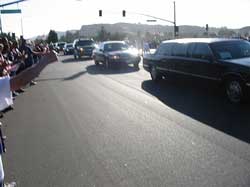
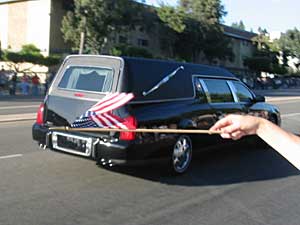 So Ronnie is home now, laid to rest in the warm California sunset. When its last receding pink edge was barely visible in the sky, to the north we could see the amorphous gray cloud formed from the smoke of his final 21-gun salute. Imaginary fire rained down on the farm fields that fill the Tierra Rejada Valley below the Reagan Library.
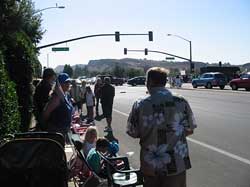
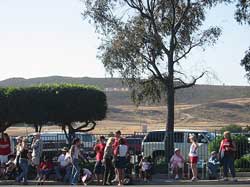
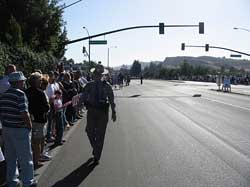
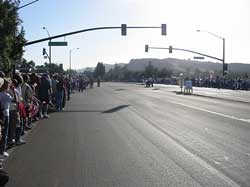
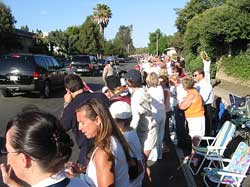
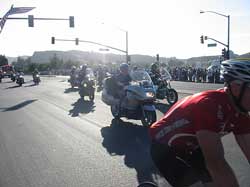
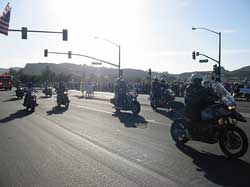
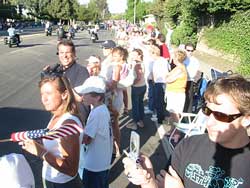
On the way home, his motorcade passed through Thousand Oaks, so JJ and I dutifully traveled a few miles over to the northern edge of the Cal Lu U campus to watch it go by and pay our respects. “Cal Lu” is where the Dallas Cowboys used to hold pre-season camp and, rumor has it, will again. Just as we arrived, a policeman pointed out Air Force Mission flying low in the sky on its way to Point Mugu Naval Weapons Station, having made a pass over the Library only a couple of miles away.
The scene along Lynn Rd. was reminiscent of a Ridgewood Fourth of July parade: chairs lined up along the sidewalks, a festive crowd restless with anticipation on both sides of the street, pockets of conversation, babies in strollers, kids on bikes and skateboards, and here and there the faint alcoholic scent of cocktails in plastic cups.
The wait got a little long. Nobody seemed to know when the motorcade would get to us. Local neighbors who’d just walked out of their houses couldn’t agree on what they’d last seen on TV. Either they’d left Pt. Mugu twenty minutes early (in which case they should have been right in front of us) or hadn’t even departed yet. So I called home and got June to spot their location for me, which at the time was coming up the Conejo Grade, meaning twenty minutes away. Always easier to wait when you know.
I learned from soccer you can watch the game or photograph the game. In the effort to get shots, I felt like I didn’t really get to see the event. On top of that, my camera automatically shut itself off just as the motorcade reached us. |
I got a few pics. Other people said they saw Margaret Thatcher though. I didn’t. And some said they saw Nancy Reagan. I didn’t. JJ felt the same way, and he wasn’t even shooting. Well, technically he was. He took a photo with his new picture phone, the new one I bought him to replace the other new one he just drowned – a week and a half after he got it. But that’s another story for another funeral.
We came back and watched the interment at the Library on TV, accompanied by guacamole and a very nice Chardonnay. I tried but couldn’t get a glimpse out the window of the smoke when they shot off the cannons, but in the hazy sky it wasn’t visible, or maybe it just needed time to collect itself and drift past the hill that blocks our view of Simi Valley.
But the geography I know well, as does JJ who observed that the fly-over was silhouetted against the homes on the hill opposite our own. And sure enough, out the window there were the three jets in the missing-man formation flying right past our house.
We ran to the back yard in time to see the fourth (missing) jet drop down back into the formation as they headed back to Pt. Mugu. Same guys who fly over the Rose bowl on New Years Day. (This seems to be a good house for plane spotting,)
We'd had house guests staying with us for two days, and I’d been heating the pool. They never got a chance to go in, but the family took a post memorial swim together, a rare evening activity for us. There’s a reason Bugs Bunny is always wearing a robe poolside in his cartoons. When the sun goes down out here, the air gets cold fast. The water temperature was up to 90o though, and no one cared about the air. It was on coming out of the pool that I made out the smoke plume.
So now Ronnie and I will watch the sunsets together. But he forever, and me not. His trip may be over, but I’ve still got more to go, and it will probably take me elsewhere, away from California. Our paths crossed right here though. At Sunset.
|
5/31/2004 - Memorial Day .... |
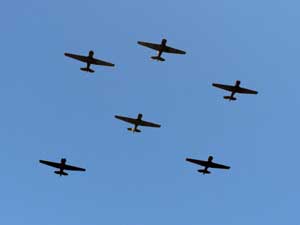
Every Memorial Day, our neighborhood gets treated to a flyover of World War II vintage fighter planes taking part in a ceremony at a cemetery a couple of miles away.
The first year we lived here, it was a little unnerving, but we figured, who would attack Thousand Oaks? Not even al Qaeda. I think they plan to live in So. Cal. if they win. What do they know about water? We were quickly able to confirm our suspicions in the LA Times, and we've looked forward to it every year. It's one thing about California even June likes.
This year they circled the other way on the first loop, away from us, but June called them over, and sure enough, they came. Right over the house.
SIU (Southern Illinois University) where I went to college was best known, at least when I was there, for drinking, and that's pretty much how we commemorated Memorial Day, as best I can remember. (We were still in session for another couple of weeks, and it helped us get ready for finals.) But Carbondale, the town where SIU is located, is tied in history to this holiday, as the following, from the US Army History website, will attest.
April 1866 - Carbondale, Illinois. Inspired by seeing a woman with two children putting flowers on graves in rural Hiller Cemetery, just outside Carbondale, Ambrose Crowell, Russell Winchester, and Jonathan F. Wiseman clean and decorate other graves that day; then organize a wider-scale memorial observance at the larger Carbondale Woodlawn Cemetery on 29 April 1866. 219 Civil War veterans march to the cemetery, Southern Illinois' own Major General John A. Logan gives the principal address. Sexton James Green makes memo of the occasion on a flyleaf of old family book, complete with date, location, etc. Carbondale, therefore makes the claim of the first organized, community-wide Memorial Day observance in United States. |
In 1866 Carbondale Memorial Association, Inc. starts movement to establish its "first" claim. Illinois Congressman Kenneth Gray introduced House Bill No. 12175 to this end, to make Carbondale's Woodlawn Cemetery a national landmark.
Details lifted from www.army.mil/cmh - US Army Center of Military History, used with permission
It was this same John A. Logan who as Commander in Chief of the Grand Army of the Republic issued what was called General Order Number 11, designating May 30 as a memorial day. He declared it to be "for the purpose of strewing with flowers or otherwise decorating the graves of comrades who died in defense of their country during the late rebellion, and whose bodies now lie in almost every city, village, and hamlet churchyard in the land."
I would add that in my youth in Maryland in the 1950s, many older people called it by its original name, Decoration Day, and that's how I referred to it until we moved to Scranton, I believe, but that would date me.
General Logan has (or at least used to have) a very nice restaurant and bar named after him in the neighboring town of Murphysboro, IL.
The following, which seems appropriate to the day, and of perhaps broader appeal than the above, is also from their site, which is worth a visit, even after Memorial Day.
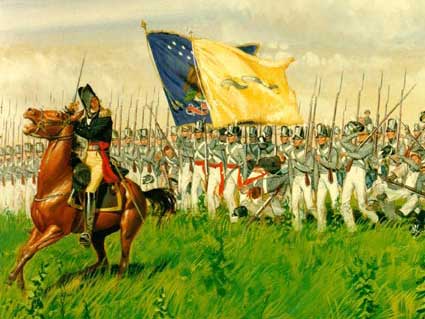
Chippewa, Upper Canada, 5 July 1814. The British commander watched the advancing American line contemptuously, for its men wore the rough gray coats issued those untrained levies he had easily whipped before. As the ranks advanced steadily through murderous grapeshot he realized his mistake: "Those are regulars, by God!" It was Winfield Scott's brigade of infantry, drilled through the previous winter into a crack outfit. It drove the British from the battlefield; better still, after two years of seemingly endless failures, it renewed the American soldier's faith in himself. |
5/27/2004 |
|
Man to parrot: "Can you talk? .... Can you talk? ... Can you talk?"
Parrot to man: "Can you fly?"
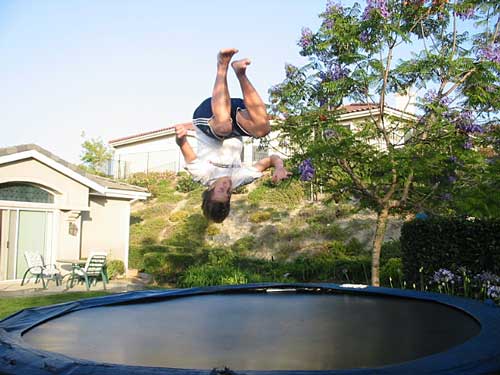
Soccer season is over, and JJ has a little pent-up energy to burn off. |
|
|