Everyone who can get on TV has something bad to say about the current crop of Republican Presidential candidates It’s hard to recall a race where the emphasis was so much on the disqualifications of the contenders, as opposed to their qualifications.
Perry isn’t smart enough, Paul isn’t realistic enough, Romney isn’t Republican enough, Bachmann isn’t factually grounded enough, Gingrich is too self-indulgent, Santorum is too pious, Huntsman is too Romney, Cain is too horny.
But maybe not enough concern is being expressed about a characteristic having nothing to do with sanity or purity or competence. Too many of them are just too darn old. One is over 75. Three others are 64 or over Several of the youngest although, for other reasons, least electable are well into their 50s.
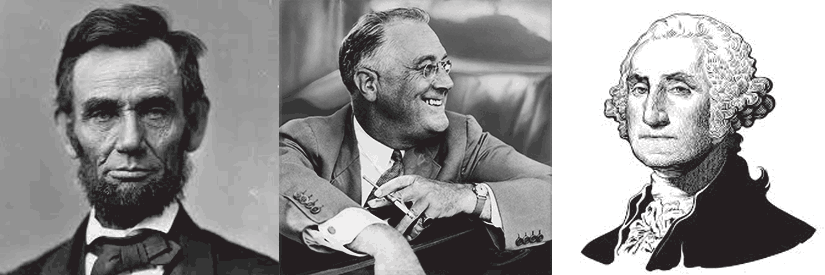
The elephant in the elephants' room this year is age. The Presidency, like the locale of the eponymous movie, is no country for old men. It isn’t now, and in truth it never was. This nation has elected a President age 65 or over just three times in 220 years (out of a possible 46). Only 10 have been over 60.
Voters sometimes came to regret the deference they'd showed toward the aged. John Adams (61 at his inauguration) had become so sot in his ways that he found Washington, DC, completely insufferable. He governed his last few years from Boston, where he wouldn’t have to come in contact with Congress and other Capitol city low-lifes. He wouldn’t even come back for his successor’s (Jefferson) inauguration.
Andrew Jackson (nearly 62) was only marginally old, but a lifetime of pugnacity had convinced him there was nobody in Washington he couldn’t personally whup. He spent eight years pretty much trying to discipline anyone who disagreed with him as a disobedient whelp.
Quotable
His mind is a jumble, an amateurish mess lacking impulse control. He plays air guitar with ideas, producing air ideas. He ejaculates concepts, notions and theories that are as inconsistent as his behavior.
Maureen Dowd
(on Gingrich)
Nobody knows what kind of President William Henry Harrison (68) might have been. He caught cold during his inauguration address, delivered without benefit of topcoat or hat on a bitterly cold day, and died in a month.
Ronald Reagan (almost 70) was pretty much beloved no matter what he did, but he was 78 when he left office and was considered troublingly senile in the later years of his second term. Everybody thought he was stonewalling Congress in his post-Presidential testimony during the Iran Contra hearings, but it turned out Dutch was telling the truth. Just about anything they asked him about, he really couldn’t recall.
George H.W. Bush (64) didn’t seem that old at first, probably because he followed Reagan, but the people only gave him one term, primarily because of a bad economy and a broken tax pledge, but also because of a growing feeling that he was just too out of touch with the modern world. He was replaced with a far younger man, Bill Clinton, 46).
Just in the last race, John McCain (then 72) turned out to be not much of a match for Barack Obama (47). He had some help but age was surely a factor.
If Newt Gingrich were to get elected to two terms, he’d be 80 when he left office. Herman Cain would be 74. Ron Paul, gasp, 83. Even the fit-looking Mitt Romney would walk down the White House steps for his last time at a relatively sedate 72, possibly with the aid of a cane.
Everybody talks about how the Presidency ages a (wo)man. And magazines love to cluck over time-lapse photos showing our leaders with their fresh outcroppings of gray hair as their time in office ticks by.
As a matter of actual fact, the validity of that concern is enthusiastically disputed by a number of authoritative personages (albeit most of them old). But true or not, a lot of voters are inclined, whatever their politics, not to give their vote to someone who’s already old starting out. How have we lost sight of that this time around?
Dobie Gray died Dec. 6, 2011. Singer, songwriter whose career spanned soul, country, pop and musical theater. The “In” Crowd (#13 on Billboard’s Hot 100 in 1965); Drift Away (#5 on Billboard’s Hot 100 in 1973). Born July 26, 1940. "Other guys imitate us, but the original is still the greatest."
12/5/11 -- Joy to the World? Or is it Bah Humbug for you?
Let your true feelings be known this Christmas. Record your holiday mood swings on this year's Christmas Spirit Index. Cast your vote at the 2011 Skelly Family Christmas Website. It's now posted. Click here!.
Dept. of You Don't Know 'Jack'
Did the previous posting in this department feel like a college course you shouldn't have signed up for? Yes? No? No matter. Here's graduate school.
Fortune: "Three ways to Guage a Scary Market"
Nov. 21, 2011
For insight on stocks it pays to keep an eye on a few key credit spreads (which right now signal trouble ahead).
The TED Spread (the difference between interbank loan interest rates and short-term U.S. Treasury bills) has more than doubled since Jan. 1 to around 40 basis points ("... a far cry from from the 400+ basis points reached during the financial crisis, but still... troubling": Gina Martin Adams, equity strategist, Wells Fargo)
The difference between yields on 10-year U.S. Government bonds and high-yield junk bonds reflects the premium investors demand for taking on the extra risk of default It hit 7.6% in October, well above the historical average of around 6% (anticipating a rise in defaults)
Credit default swaps spreads for sovereign debt (contracts that insure a buyer of debt against the possibility of default) monitor the sruggules of European economies. France's five-year CDS spread stood at 1.9% in October, almost double the cost in January.
 
(Editor's note: If you need a chart to tell you that sovereign European debt is dicey just now, you should probably be avoiding the market altogether for the near term.)
11/18/11 -- ROCK 'n ROLL’s (rather long) Magic Moment
No one really knows who put the Ram in the Rama Lama Ding Dong, but it was Leiber and Stoller who made strings a defining element of Rock & Roll music. They did it in 1959.
The song was There Goes My Baby, released by The Drifters on Atlantic Records. The instrument was violins, and the sound was one The Drifters and everyone else would turn to again and again for years to come.
The Drifters followed There Goes My Baby in swift order with Dance with Me, Save the Last Dance for Me, I Count the Tears and This Magic Moment, all produced in 1959 and 1960. How’s that for a run?
There Goes My Baby was written by Ben E. King, Lover Patterson, and George Treadwell, and produced by Jerry Leiber and Mike Stoller, whose musical accomplishments would eventually be immortalized on Broadway in Smoky Joe’s Café. And who counted among their junior employees at one time or another Carole King and Neil Diamond.
All household names now. Back then, their futures were all still unwritten, laying in wait for them.
The Drifters were more than just a singing group, they were a business. The best analogy might be to a modern-day corporation that follows a business model which stresses underpaying current employees and dealing successfully with high turnover.
There Goes My Baby was the first single by the second incarnation of The Drifters, a bunch of replacements previously known as the 5 Crowns who assumed the "Drifters" name in 1958 after the lead singer left and manager George Treadwell fired the rest of the original lineup.
The group was aptly named. Anybody who got anywhere with The Drifters eventually moved on because Treadwell, who controlled all the money, didn’t want to pay anybody. They were like the early Oakland A's of pop music, and Treadwell was Charles O. Finley. No matter who they put in the lineup, for years on years they just kept on winning.
Leiber and Stoller had worked with the original group as well, headed by lead singer Clyde McPhatter who had left to pursue a solo career and more money.
They went for a different song structure with this new group, incorporating both violins (which had already been used by at least one other group but not to the same effect) and Brazilian samba rhythms. The combination of new style, new sound and new singers fit together just fine. The song reached number two on the Hot 100 and number one on the Billboard R&B chart and on the Cash Box sales chart for two weeks, in the summer of 1959. The Atlantic Records release marked, as well, Ben E. King's debut as lead singer of The Drifters.
Ben E. King left the group, too, in 1960 despite the torrent of hits. Guess why? To pursue a solo career and more money. He scored pretty much right out of the gate with Rose in Spanish Harlem, and followed that hit up with Don’t Play that Song (You Lied) and the pop classic, Stand by Me. The soundtrack of the eponimous movie starring River Phoenix, Corey Feldman and Kiefer Sutherland among others would reprise King's musical fame two decades later.
The sound of strings eventually went on to fuel both Phil Spector’s Wall of Sound and the Motown Sound. Other folks, like Electric Light Orchestra, were kind of fond of them, too, over the years.
The Drifters' all-time biggest-selling hit
And the Drifters? They continued evolving and revolving, featuring changing personnel and a succession of lead singers including Rudy Lewis, Charlie Thomas and Johnny Moore, putting out hits like Please Stay, Some Kind of Wonderful, Under the Boardwalk, Up on the Roof and On Broadway.
Today folks don't always know which iteration of the group they're talking about, but very few who ever heard them sing didn't love The Drifters. All of them.
Thirsty for more? Click Here for a reasonably complete discography of The Drifters' oeuvres as well as links to documentary materials and a YouTube Drifters playlist.
Dept. of You Don't Know 'Jack'
Why you will never make money in the market
The Charlotte Observer: "Money and Markets"
Nov. 13, 2011
S&P 500 companies are on track to report $23.78 per share in 3rd-quarter earnings, topping last quarter's record $22.24. The last time profits were that high was 2Q07, when they peaked at $22.18, before the recession. The U.S. economy grew more strongly than expected last quarter, says Citi economist Steven Wieting.
Analysts expect profits to keep rising. They forecast S&P 500 profit growth of 15% in the 4th quarter. "This remains the strongest corporate earnings recovery on record," says Linda Duessel, stock strategist at Federated Invesors.
American Research Group Survey
released Oct. 21, 2011
A total of 58% of Americans say the national economy is getting worse and 17% say it is getting better.
S&P total per-share earnings and prices: Q1 2007-Q3 2011
11/9/11 -- Math Problem
MS Initiative 26 was supposed to be a nail-biter. The "personhood" amendment would have established that human life begins in Mississippi at fertilization. It failed, handily, by a 58%-42% margin.
The steady drumbeat from the press was that it was a hugely important vote with huge repercussions, and it could go either way. Polls showed before the election that 45% of voters were for it, 44% against and 10% undecided.
Today they’re reporting the outcome was a foregone conclusion. The amendment went too far. People weren’t willing to cede control of a personal issue to the government. Even the churches were divided, with some clergy fearing it might backfire if it got to the Supreme Court.
It was misguided. It was too vague. It was too complex. The governor, who voted for it, said it was done all wrong and probably should have gone through the legislature.
So what happened to “nail-biter”? How did they get it so wrong? Well, it was a really good story, it stirred people up on both sides, it fed our darkest fears about each other. And it hung around, so you could fill up pages and pages by going back to it again and again. And it wasn’t very expensive to cover.
Quotable
History shows that popular technology is often supplanted by entirely new models.
Eric Schmidt Executive Chairman, Google Inc.
Besides, not everybody did get it wrong. The Baptist Press News Wire Service called it the day before the vote. They thought its prospects were bleak, based on the numbers, citing a survey done the week before by Public Policy Polling. Their story just wasn’t nearly as exciting, so it kind of got overlooked.
Men (48-42 percent), Republicans (65-28) and whites (54-37) support it, while women (42-46), African Americans (26-59) and Democrats (23-61) oppose it. The 11 percent who are undecided could determine the measure's fate. Of undecideds, 58 percent are women, 54 percent Democrat and 42 percent black.
"Those still on the fence disproportionately belong to voter groups that oppose the amendment," Public Policy Polling said.
Putting aside a momentary question of why opposing abortion seems more important to men than women, the lesson would seem to be this. If there’s one segment of society worse than politicians when it comes to an absence of collective memory and the correlative embarrassment that should accompany it, it’s the press.
Journalism is the opposite of history. There is no yesterday to the media, so what they said then is never an issue. They entertained you as best they could. Now all they ask is, just look at this new headline. And maybe if some of you, in this age of the internet, could just pay up for it?
For the next lesson, maybe we’ll address why absolutely anyone would think something of such fundamental importance as when human life begins, involving as it does myriad, complex and thorny theological, scientific and medical considerations, might be resolved by turning it into a popularity contest.
10/31/11 -- Trick or Treat
Happy Halloween! Click the pumpkin face for Sammy's annual Halloween economic forecast and advice to his grown-up children.
They don't listen to a word he says.
10/19/11 -- Debit Cards Losing Value?
Banks want to charge you for using your ATM card as a debit card. Bank of America just announced a $5.00 monthly fee will go in effect after the New Year. Season's Greetings.
Does anyone recall that it was the banks who encouraged us to pay for purchases with a debit card in the first place? Checks, (which is how you used to pay for your groceries, remember?) are expensive, labor-intensive and time-consuming.
Plus, most people don't think about it this way, but a bank's debit card business (the retail bank) is actually competing with the credit card division for payment mechanism fees. They are battling for the right to handle your payments.
Think of it as friendly competition. It's like the bank CEO has two big dogs and likes to watch them fight, with other dogs and with each other too. Ask Michael Vick.
The ATM card stacks up pretty well as a payment mechanism. Debit transactions cost about 17 cents apiece. They're so cost-effective that they have a smaller profit margin than a credit card does. Credit card transactions go through many hands in settling. A debit card settles between the merchant and the bank directly. And there's less credit risk.
They still turn a profit though. Before the Dodd-Frank bill, banks charged merchants about 44 cents to handle each debit transaction. (You paid nothing. You smell a rat already, don't you?) Now the debit card merchant fee is capped at 25 cents. That still ekes out a profit, but Sen. Dick Durbin (D-IL), who championed the reform rule on debit card fees, must have felt it seemed a little more reasonable and a little less like gouging.
But For 25 debit transactions a month, the bank used to get about $10 in fees. Now they’ll get half that. They don't know from gouging, and they don't care. They want their five bucks back. And banks are entitled, no? They have to make their money somewhere, right?
Only the idea behind debit payments in the first place wasn’t fee generation, it was cost reduction. Such payments saved banks a fortune over check processing. About 30% of checks are generally written on the same bank as the one a merchant does business with, it's estimated. The rest have to go through a clearing bank. Takes time, takes money. Merchants didn't like it either. They had to wait for their money.
But what's past is prologue as the poet said. Banks not only want to get their five bucks back, they want you to get an object lesson in why government regulation is bad for you. See? Dodd-Frank is costing you money. They're forcing the banks to hurt you.
In short, banks are just showing their pique at being saddled with as toothless a bit of bank reform as has come down the pike in some time. Concept rich; detail light. So far only 38 out of 400 rules have actually been written, including this one. It's been a very good year for bank lobbyists.
What to do? Well, you could just swallow the fee. After all, if you do 30 transactions a month, $5.00 is about what you're costing the bank in processing fees. (Although on top of your five spot, the banks will still be harvesting that 25 cents per transaction from the merchant). Or you could start carrying really large amounts of cash.
Or, you could go back to writing a check for purchases. Most merchants still take them. A little slower, a little more cumbersome, but ironically, that outdated and costly payment mechanism remains free for most bank customers. For now.
P.s. This posting started out as a letter to the editor at the local paper. Only they didn't print it. They only seemed to have room for letters supporting the reasonableness of the fee. See, Charlotte sill thinks of itself as a banking town.
10/8/11 -- Paul Takes Values Voter Straw Poll
Values Voter Summit, Washington, D.C., Oct. 7-9
candidate
vote
Rep. Michele
Bachmann (MN)
Herman
Cain (form. talk show host, CEO)
Newt
Gingrich (form. House Speaker)
Jon
Huntsman (form. U.S. Ambassador to China)
Rep. Ron
Paul (TX)
Gov. Rick
Perry (TX)
Mitt
Romney (form. Gov. MA)
Rick
Santorum (form. Sen. PA)
Undecided
"Paul has a history of scoring surprising straw poll wins by packing the electorate with his diehard supporters. Even so, the Values Voter Summit represents a setback for Perry, who is counting on voters who share his socially conservative views to help power his candidacy into the top tier of Republicans." (National Jurnal)
10/7/11 -- 1,000 Words: How Long Did You Think It Would Take?
Job Recovery Could Be Slow And Weak
As losses mount, economists fear that hiring could be a problem even after the recession is over.
December 5, 2008
Five Myths About How To Create Jobs
1. Surely there's a quick fix.
The country would need to create more than 200,000 net new jobs each month for the next seven years to get unemployment back to what was once considered a normal 5 percent.
February 7, 2010
U.N. Says Global Employment Needs 5 Years to Rebound
To get back to the level of employment in 2007, the global economy needs to create nearly 23 million jobs, including more than 14 million in developed countries.
September 30, 2010
The Quest For Jobs
Even if growth accelerates, unemployment will remain worryingly high for several years.
September 10, 2011
Editor's note: Number of months with 200,000+ non-farm employment gains since 2001:
'01: 0; '02: 0; '03: 1; '04: 4; '05: 5; '06: 5;
'07: 2; '08: 0; '09: 0; '10: 2; '11: 2.
9/27/11 -- The Summer of '11
Summer's over. Carry it in your heart from now on and forever. Or wasn't it one of those summers for you? Maybe Halloween will be kinder. Anyway, here's your top 20 Summer Song Jukebox Plays, Memorial Day to Labor Day, 2011. Ah, the memories....
1) Under the Boardwalk The Drifters (1964)
2) Summertime Blues Eddie Cochran (1958)
3) One Summer Night The Danleers (1958)
4) Yesterday's Gone Chad and Jeremy (1964)
5) Summer Song Chad and Jeremy (1964)
6) Gone in September Mike Posner (2010)
7) In the Good Old Summertime Julien Neel trudbol (1902)
8) Surfer Girl The Beach Boys (1963)
9) The Boys Are Back in Town Thin Lizzy (1976)
10) Summer Of '69 Bryan Adams (1984)
11) California Gurls Katy Perry (2010)
12) Summer Rain Johnny Rivers (1967)
13) The Lonely Surfer Jack Nitzsche (1963)
14) You Took the Words Right Of My Mouth Meatloaf (1976)
15) Dancing in the Street Martha and the Vandellas (1964)
16) Wipeout The Safaris (1963)
17) Boys of Summer Don Henley (1984)
18) Suddenly Last Summer The Motels (1983)
19) Sealed with a Kiss Brian Hyland (1962)
20) Summertime, Summertime The Jamies (1958)
9/24/11 -- Cain Surprises in Florida GOP Straw Poll
Presidency 5 Straw-Poll, Orlando, FL, Sept. 24
candidate
vote
Rep. Michele
Bachmann (MN)
Herman
Cain (form. talk show host, CEO)
Newt
Gingrich (form. House Speaker)
Jon
Huntsman (form. U.S. Ambassador to China)
Rep. Ron
Paul (TX)
Gov. Rick
Perry (TX)
Mitt
Romney (form. Gov. MA)
Rick
Santorum (form. Sen. PA)
The Florida Straw Poll hath spake, and now it’s all over, says that state’s chief executive Gov. Rick Scott (R). He notes that the Florida Straw Poll is historically an unerring predictor of the eventual Republican Presidential nominee. In that it’s been right all three times it’s been held. (Reagan won in ‘79, Bush Sr. in ‘87 and Dole in ’95; it was not held in 1999 or 2003; Presidency 4 had no poll in 2007.) Technically that meets the definition of "unerring," but with that thin a track record, it shouldn’t be too surprising if the results this time don’t settle all debate.
The NBC News website First Read said candidates have sometimes been reluctant to participate in a poll requiring them to shift time and resources to the large, expensive state like Florida. Presumably, the concentration of a Faith and Freedom Coalition Rally, the FOX-Google debate, and the Florida CPAC gathering all in the same week this year made the effort seem worthwhile. Even so, there was less active campaigning this time. Romney and Bachmann informed organizers up front they did not plan to participate. Cain, Santorum and Gingrich spoke at the Saturday convention. Paul, Perry and Huntsman sent representatives to speak in their absence, although Perry hosted a delegate breakfast earlier in the day.
“Iowa basically is a paid straw poll,” Blaise Ingoglia, co-chair of the organization putting on the straw poll, told NBC. “This is actually more of a true representation of how the voters are going to vote in Florida.” The eligible voters are some of the most passionate Republicans in the state. Some 3100 who applied earlier in the year were chosen by lottery and paid $175—which gave them the opportunity not just to vote but to attend an array of Republican events. Another 300 or so were selected by the state party chairman. The overall delegation is supposed to represent the geographic makeup of the state.
8/23/11 -- 2,000 Words: Where the Train Left the Tracks
Click to enlarge charts
Can you spot precisely (point with your finger) where the Obama spending spree spun out of control?
Might the country also have a revenue problem?
If employment tracks with GDP, how much will spending cuts hurt employment?
Can you make heads or tails out of these charts?
Do you think John McCain can?
How about Rick Perry or Michele Bachmann?
8/13/11 -- On Her Knees in the Night, Saying Prayers by the Street Light
That Rick Perry, he’s some slick politician. Even if Michele Bachmann won the Iowa Straw Poll, she’d still have to split the headlines with the Texas Governor. And a lot of people think that’s the last time they’d ever be tied.
The honest-to-God truth? In terms of actually getting the nomination, Bachmann never really had a prayer. Maybe she’ll lose out to Perry along the way, but it’s more likely she’ll be seen as merely setting up the table for Mitt Romney. Sucking all the oxygen out of the room and suffocating the likes of Pawlenty, Huntsman, Paul, Cain and the rest who, let’s face it, were barely breathing anyway.
Perry probably wouldn’t be any more successful than Bachmann in overtaking Romney, but he’d have a better chance. That Newsweek cover photo wasn’t that far off the mark. Tina Brown and a broad swath of the electorate know in their hearts that Bachmann is what you’d call a religious fanatic. The fat cats in the Republican Party know it, too.
A long historical record demonstrates how poorly devout types ultimately fare in the political arena. Look at William Jennings Bryan. Look at Thomas Moore. Look at Joan of Arc. Look at Jesus Christ.
Does anyone really think Karl Rove was going to let Michele Bachmann run the Republican Party? Does anyone think David and Charles Koch were going to let Karl Rove let her run the Republican Party?
This is not to dismiss Bachmann out of hand. Doyle McManus pointed out in the LA Times, “She has managed to turn the primary campaign into a straightforward, head-to-head contest between two versions of modern Republicanism: her insurgent tea party conservatism and the more traditional, big-business conservatism of Romney.”
But that was always where it was going to end. In the Republican Party, the smart money will always bet on the smart money. Basically Bachmann cleared out the riffraff, better probably that Romney could have himself.
The path of the devout is arduous. Most of us are simply not ready to follow it. Once people get the full wonder of Bachmann’s brand of conservative reconstructionist Christianity digested, their collective reaction is likely to be that where she wants to take us is just not worth the journey. We're not worthy.
Too many rules. Too many demands, too many beliefs, many of them a little hard to swallow (especially if you happen to be not Christian in the first place or even just the wrong kind of Christian).
Bachmann is the product of a school of thought that sees the destiny of America as that of a definitively conservative Christian state, ruled by conservative Christians and for conservative Christians.
Her intellectual mentors at Oral Roberts Law School taught her that whenever American law came in conflict with their interpretation of biblical law, adherents should try unrelentingly, through legal and political means, to get the former to change. (Sounds a lot like Sharia Law, no?)
Gene Wilder to Marty Feldman: "Damn you eyes!"
Feldman to Wilder: "Too late!"
(Young Frankenstein)
She wants a constitutional amendment banning abortion.
She wants the same for gay marriage. She rejects evolution and wants it mandated that Intelligent Design be taught in public schools. These positions are ironic since they would likely create a bit more government than Republicans say they want. Many opposed to abortion and gay marriage and even biology might be uncomfortable with extending the government’s reach into what may be at some level private matters.
Many of Bachmann's views are guided by an almost mindless—certainly an
unyielding—certitude, one seemingly impervious to mere facts. No matter how skilled a politician she becomes, and she’s getting better all the
time, one suspects the closer the discussion gets to exposing her core
beliefs, the more voters are going to fidget.
While we might not admit it in public, a lot of us get nervous around people who think
they have an ongoing conversation going with God, one where he answers back and provides detailed directions. That creeped people out about George Bush, and everyone knew he didn’t even really mean it. Ever since the days of enlightened despotism, the march of democracy has kind of been away from that kind of thinking.
She may feel she’s all “Onward Christian Soldiers,”
but for a lot of people it might feel more like Coolio’s “Gangsta’s Paridise.”
What next for Bachmann? She should consider moving.
To Greenville, SC, where she’d find a lot of like-minded, kindred spirits. She should go down there with Sen. Jim DeMint.
With his quest to “save souls” in Congress he’s not feeling very much love in Washington anyway, even from his fellow Republicans. He knows South Carolina, and could be very helpful with introductions.
A large contingent of folks in the region think just like Rick Perry talks: about seceding from the Union, creating their own idyllic Christian state and letting the rest of the world go by.
That ship sailed 150 years ago. But there’s nothing to stop them from creating their very own political party. To build one with the requisite scale to actually change the direction of the country would take a lot of money, of course, and it’s unlikely they could get that from the Republicans,
But if she made her goals clear and played her cards right, there’s money out there. There’s a good chance the DNC, for instance, might be willing to chip in and lend a hand. And they’ve got real money. Obama has fat cats, too, and once they fully grasped the idea, they’d probably be glad to help her out.
7/31/11 -- Divisive We Stand
The way House Speaker John Boehner won the support of recalcitrant members for their own party’s debt ceiling bill was to propose a balanced budget amendment for the US Constitution. Basically the same proposal Republicans had earlier approved in their previous “Cut, Cap and Balance” legislation, which passed the House on a party-line vote before vanishing into the dustbin of the Senate’s history.
Basically, President Obama said we should “eat our peas,” so Speaker Boehner trumped him by proposing to add an “eat your peas” clause to the Supreme Law of the United States.
Republicans of late seem inclined toward constitutional amendments as the way to settle a variety of matters, frequently ones they’re in the minority on. It’s an idea that has come up with respect to gay marriage, abortion, and immigration(where they would actually be amending an amendment, one passed in 1865 that made the descendents of slaves, and anyone else born here, US citizens. That amendment was approved by their Republican ancestors, but now they don’t like the idea so much.
Historians would point out this is a different Republican party. The one in the 1860s was considered in many respects a party of progressives. Recall that at the time, many Conservatives, particularly of the southern persuasion, regarded Lincoln as a big-government tyrant hell-bent on leading the nation down the road to socialism (even though they didn’t really know what that was yet)..
Lately, you can’t show Republicans a constitutional amendment they’re not in favor of. The last one they were against was the Equal Rights amendment in the ‘70s (which passed Congress but which the states failed to ratify). This seems somewhat ironic. The current Republican-controlled House of Representatives convened with a reading of the complete US Constitution, (although they inadvertently skipped part of Article IV.).
The idea was to showcase that party’s Constitutional devotion and their commitment to passing only laws that conformed to its tenants (a requirement Congress is actually already burdened with). But given their regularly-invoked desire to alter its contents, one is inclined to wonder what it was they saw in the document that they liked so much in the first place.
Since its ratification in 1789, the US Constitution has been amended 27 times. Ten of those were done in a group at the Constitution’s inception and are referred to, as every school child knows, as the Bill of Rights.
There was a flurry of amendments around the end of the Civil War, of course. And then again around World War I concerning the right to vote (women) and the right to drink (everyone). That latter, well-intentioned amendment (passed while most of the drinkers were out of town) was, upon sober reflection, subsequently rescinded, by means of another amendment, which is the way the Constitution works.
Signing of the U.S. Constitution at Independence Hall in Philadelphia on September 17, 1787, by Howard Chandler Christy (1940). The painting is so large Christy painted it in a sail loft. Currently on display along the east stairway in the US House of Representatives.
There really haven’t been all that many amendments if you exclude the Bill of Rights, the temperance flip-flop and several unexceptional changes to the order of succession to the Presidency and mundane changes to terms of office for the President and Congress.
But such stability belies the inner unrest of this country’s political beast. Some 10,000 amendments have been proposed since 1789. In modern times, about 200 or 300 proposals surface every year. Most go nowhere, but clearly a lot of people are unhappy with the Constitution, lip service to the contrary. And the truth is, it was that way from the beginning.
Patrick Henry of Virginia, whom school children from an early age are taught to revere for the fiery rhetoric of his patriotism, had nothing good to say about the US Constitution. He called it, "the most fatal plan that could possibly be conceived to enslave a free people."
The mechanism for changing the Constitution was built into the original document. It’s no simple matter, of course. The Framers didn’t want it to be too easy in order to discourage ill-conceived, half-cocked or hastily passed amendments.
The U.S. Constitution on display at the National Archives.
To date all amendments, ratified or not, have been proposed by a two-thirds vote in each house of Congress. However, if two-thirds of the state legislatures demand one, Congress must call for a constitutional convention, which would have the power to propose amendments. After passing Congress, an amendment must also be ratified by three-fourths of the states (either by state legislatures or special state conventions.)
Actually, the Bill of Rights was a defining issue in the Constitutional debate that took place among the young nation’s 55 delegates in Philadelphia in the hot, hot summer of 1787. Lots of people felt no fashionable Constitution of the time could be complete without a specific delineation of individual rights. Federalists felt the rights were already delineated and one wasn’t necessary; anti-Federalists made their approval contingent on one’s creation.
You probably know this already, but the whole point of the Constitutional Convention was to create a more powerful federal government. Many influential founders, like George Washington, felt the country couldn’t get anything done under the Articles of Confederation. But even back then there were many who feared the encroaching power of big government.
So the Bill of Rights was a way to calm folks down while still making it possible to raise the money needed to pay an army and, important in a country that didn’t have many, particularly to the suburbs, build the roads that would support national expansion.
In short, the Bill of Rights was a compromise meant to mollify the feelings of delegates that the new Constitution was too much about how things worked and not enough about championing individual rights against the powers of government.
(Originally, the Bill of Rights included legal protection for white men only, excluding most Americans and all women. It was left to subsequent amendments, a civil war and any number of Supreme Court cases to extend the same rights to all U.S. citizens.)
It has become fashionable among some modern politicians and pundits to characterize our founding fathers somewhat sentimentally as a monolithic and single minded-corps. Actually they were a contentious and disagreeable bunch. That they got anything done at all was actually their single biggest accomplishment.
The US Constitution was borne of many compromises, as well as tacit agreements to ignore some matters deemed too sensitive to even compromise on. Most notably, the whole issue of slavery was passed over by the Framers and left to be settled a hundred years later with a war of secession that nearly succeeded in tearing the country in two.
Other major sticking points requiring negotiated compromises, or left wholly or partly unresolved, included large state versus small state representation, business versus agrarian interests, tariffs, executive elections, the extent of the federal government’s power, the exact role of the office of the President, and even the length of the terms of Senators.
In point of fact, the Bill of Rights amendments were ratified in 1791 three years after the Constitution, but in many states it was understood they were coming and voters based their ratification on that understanding.
Eventually all thirteen states ratified the Constitution. Some did so unanimously, but in others the votes were quite close: Massachusetts 187 – 168; New York, 30-27; and Rhode Island 34-32.
Rhode Island never did like the idea of the Constitutional Convention in the first place, and had refused to even send a delegation. Patrick Henry declined the opportunity to serve as a delegate himself but agreed to attend as an advisor to the Virginia delegation. He advised, vehemently, against.
Clearly, many delegates were less than pleased with the results of the effort, Bill of Rights or no. Thirteen Founding Fathers not only refused to sign the new Constitution, they left the convention before it ended and went home. Another three stayed on but still would not sign the final document.
7/8/11 -- "But Miss Scarlett, where we gwine get 400 billion dollars?"
They say you never get a second chance to make a first impression. But our elected officials in Washington are now demonstrating that it’s never too late to look good tackling an old problem. Namely, the deficit.
So it seems only fair that you, loyal visitors, also get a second shot at fixing the budget, only this time under new, more generous rules.
Washington's new goal is to cut $4 trillion in spending. How can they do that when spending only amounts to about $3 trillion annually? Well, what they’re talking is over a decade. Why do they do that? Most likely because it sounds more impressive than $400 billion, which is the annualized hit they’re really talking about.
Now that’s your new goal, too. Much more achievable, no? Give it a shot.
What’s the point if that’s only about a third of the deficit? Listen: These guys may be stupid, but they’re not as stupid as you think they are. How do you think they got you to vote for them in the first place?
First, $400 billion in annual cuts when combined with $400 billion in new revenues suddenly covers two-thirds of the deficit. Second, remember the recently popular Republican mantra about how we don’t have a revenue problem, we have a spending problem? Well, as you probably figured out (because you’re not as stupid as they think you are either), we’ve had both ever since the recession came to live with us.
Each year, revenues now come in a bit short of where they used to. Guess by how much? $400 billion. Trifecta! If we could just get back to where they were in 2008—as Obama gets down on his knees every night and prays they will—voila: The deficit is gone. Think he doesn’t want a deal? With all his heart. That way, he can eat Romney’s heart in the next election. Right in front of him.
Imagine the Republicans dropping an opportunity like that in his lap. Also worth noting, Obama is apparently thinking more along the lines of $100 billion in new revenue. So even if he were to get the deal, it would still come up a little short.
But just in case, go to work. Do your part. And then don’t forget to pay your taxes. Both the new ones and the old ones. You don't hear much about it, but the biggest problem Greece has is they don't pay their taxes over there.
(One little caveat: remember when Roosevelt cut spending and raised taxes mid-way through the Great Depression. Of course, you don't. You're too young. So are these guys.)