Well, maybe you do and just don't get enough credit. Here, at least, is a chance for you to prove it.
The "Full Civic Literacy Exam" is a creation of the Intercollegiate Studies Group, which could possibly be the largest educational organization you never heard of, at least if measured by map pins. It has only about 10,000 student members, but they're on some 1,500 campuses across the country.
The Institute conducts "an integrated program of campus speakers, conferences, seminars, publications, student groups, and fellowships and scholarships, along with a rich repository of online resources." It is unabashedly right-wing. William F. Buckley, Jr., was ISI’s first president.
The test is an interesting and fairly straightforward assay of knowledge of civics, current events, history, government, and finance. (Without bias.) Take a shot and see how you stack up. If nothing else, you'll probably learn you are smarter than a whole bunch of college educators. Exactly who's in this category is not immediately clear, but they got an average score of only 55%.
Summer, like an anxious teenager, came a little early this year, driven by a surge in updating activity that in turn caused a spurt of early visits to the Summer Song Jukebox.
So what better way to launch the beach season than reviwing just which memories visitors tuned in to listen to this spring. Here's the top 10 list.
1) Girls in the Summer Dresses (new) Bruce Springsteen
(2008)
2) Yesterday's Gone (new video) Chad & Jeremy (1964)
3) Summer Song (new video) Chad & Jeremy (1964)
4) Summer Night City ABBA (2010)
5) All Summer Long Kid Rock (2008)
6) California Gurls Katy Perry (2010)
7) Dancing in the Street Martha and the Vandellas (1964)
8) Summer Of '69 Bryan Adams (1984)
9) Theme From A Summer Place Percy Faith And His Orchestra (1959)
Among those that just missed the cut: Our Last Summer (ABBA), Gone in September (Mike Posner), Summer Rain (Johnny Rivers), Boys of Summer (Don Henley), and On the Way to Cape May (Tommy Zito - What is the matter with you people?)
Check back again after Labor Day and see how your summer went. Meanwhile, don't forget to use sunscreen, stay safe in the water, and be careful when making your memories. They tend to last a long time.
5/4/12 -- 1,000 Words: "Dow Closes Down 168 Points on Weak April Jobs Report" (AP)
It is silly to answer a modern question by imagining thoughts that dead people never thought. The Framers had no intention about gun control because they never thought about it. Neither did the people who voted to ratify the Constitution.... Guns, like limited suffrage, were taken for granted. As Newton could not have imagined a regime where his formulae do not work (Quantum Mechanics), neither could those men have imagined one without private guns or one where women voted.
4/19/12 -- 1,000 Words: 62.5% Say the Country Is on the Wrong Track
Source: St. Louis Federal Reserve.
4/17/12 -- Lies, Damned Lies and Statistics Department
Your mom ever tell you, “If something sounds too good to be true, it probably is”? Mitt Romney’s mom, evidently, did not. Nor did the mom of his press secretary, Andrea Saul, who supposedly did the math on Romney’s celebrated women’s employment factoid.
“Romney campaign says 92.3% of the jobs lost under Obama were women's jobs.”
This claim is based on the same rationale Max Bialystock and Leo Bloom used with “Springtime for Hitler,”
their Broadway play that would make them wealthy because it was sure to be a box office disaster.
How does that work? Simple. People don’t pay too much attention to numerators and denominators in their daily struggles. Your head hurts already at the mere mention of numerators and denominators, doesn’t it?
Even the jaded are thinking to themselves, “I may not like the man, but could that statement really be true? What could Obama have done, aside from be Muslim, to cause a whole bunch of women specifically, and not men, to lose their jobs?” And the suspicion would be justified.
This type of rhetorical fallacy is called post hoc ergo propter hoc. The math is correct. But the inferential presumption that there’s a causal relationship between two separate events (a. Obama walks into the White House in the midst of a recession and b. the employment figure for women as a percentage of total employment goes down by x in y months is neither supported nor persuasive. Having observed the correlation, one is obligated to make the case. (It happened because he did this or that.)
Frankly that would be such a lot of work. And anyway the math is much more fun, so let’s just do the math.
How did they come up with that number? It, like the syllogisms you learned to create in college, is valid. But that doesn’t necessarily make the conclusion true. Remember syllogisms, way back in freshman year? No? Well, it turns out it’s something you should have held on to if you wanted to be an informed political audience in 2012.
Depending on how high you were back then, the following may or may not help you: Syllogisms would have come right after the cursory grammar, spelling and punctuation review but before the study of literary conventions like metonymy or litotes and rhetorical fallacies like argumentum ad hominem or the aforementioned post hoc ergo propter hoc.
A little over the top? Okay, just try this.
The Great Recession officially began Dec 2007 and ended July 2010. Before 2008 we were gaining jobs. And we’ve been gaining them since Oct 2010.
Basically the economy lost jobs between Feb 2008 and Oct 2010. (Women’s employment continued to rise through March 2008.) Here’s how that unfolded, broken up into bite-size chunks.
During the period, women comprised about 49% of the workforce, and they lost 35% of the jobs, so actually they fared a little better than men. Sorry, Mitt.
Both men and women began gaining jobs in Oct. 2010. Proportionally, more men lost their jobs before Jan 2009, and more women lost their jobs after Jan 2009. The public sector didn’t start shedding jobs until 2010 but has still not yet shown any real job growth.
Here’s what the Romney folks calculated, using a slice of that history.
Job Losses: Romney Time
women
men
Jan '09-Mar '12
-683,000
-57,000
% gain(loss)
-1.0%
-0.1%
Women's losses as pct. of total in period: 92.3%
There’s nothing wrong with that math, but it doesn’t tell you very much about what happened. It’s merely a reflection of diverging trends between two populations with different characteristics within a narrow (and not representative) time frame of a larger historical period.
Whew. A mouthful, no?
(They could have painted an even worse picture by using statistics for private sector employment only, rather than total non-farm employment, which includes public sector jobs. Then the percentage of jobs lost by women would have risen to 150% of jobs lost. But as soon as you saw that, alarm bells would have been going off. Doubtless they thought it would be easier to sell the 92.3% figure. Nobody said they were stupid. (Certainly not Newt Gingrich or Rick Santorum.)
To measure job loss in a meaningful way it behooves you to measure from when the losses started. Otherwise you’re just messing around with numerators and denominators. You can’t really divide the recession up into the Bush recession and the Obama recession.
And if you keep measuring after the declines have reversed themselves, well then you're measuring the recovery. Which is also valid, but different.
Ignoring such niggling details just skews up your numbers. A little like pointing out that a man drowned in a creek with an average depth of three feet. Or saying the Yankees should get the "W" because they outscored the Sox in the last three innings. Statistics is funny stuff.
The one thing Obama might conceivably have done wrong is not to take office sooner. If he’d become President in January 2008, for instance, women would have done much better on his watch.
Democrats would probably be quick to argue everybody else would have, too, although that might be leaping to conclusions. Yet again.
3/22/12 -- What Has Romney Learned?
Mitt Romney has dismissed both challenger Rick Santorum and President Barak Obama as economic lightweights, in contrast to him, an economic heavyweight. Ah, two targets with one shot.
It remains to be seen whether the likes of Alan Blinder, Andrew Samwick, Tim Geithner, Larry Summers, Ben Bernanke, Christina Romer or Paul Krugman would recognize him as one of their own. Most of those folks have a PhD in economics (not Geithner) and years of service as a practitioner in the field. They have held actual heavyweight positions in academia and government as well as the private sector and are published, recognized authorities on the subject.
A 1984 photo of Mitt Romney and his Bain Capital partners flush with cash, used here unfairly out of context.
More to the point, one doesn’t see economists clamoring to be President. They're happy to advise, for a while, but don’t generally want the job itself. You don’t even see that many CEOs running for President. There were Pat Robertson, Donald Trump (however briefly) and Ross Perot, but mostly one sees politicians. (It's hard to know whether Herman Cain was ever really serious.)
Past performance as an economist or CEO doesn’t guarantee future success as a politician. Lee Iacocca thought just the opposite. Maybe there’s a reason Romney was a one-term governor and came in second in his 2008 Presidential primary run and in his only congressional race.
There's an arugment to be made that if Romney can convince the Republicans he really is a conservative, there could be no better testament to his political chops. Others might feel it would carry more weight if he’d actually run against any viable candidates. A school of thought holds Romney has won nothing in the primary campaigns; it was inevitable the others would all find a way to lose.
No matter. One wonders what Romney thinks he knows that has escaped legions of highly trained economists. Surely it involves more than just eliminating capital gains, cutting taxes on high-earners and unfettering the country’s business and industrial might from the bonds of excessive regulation. These bromides are hawked by every Republican who roams the earth. Could it be, like Sen. McCarthy’s list, Romney’s knowledge is more concept than construct, perhaps even more ephemeral than real? McCarthy never divulged his list.
Even conservative economists concede there is likely no way out of the deficit problem that doesn’t involve increased revenues (See Frum Forum’s Conservative Economists: Raise Revenue.) That’s because, contrary to the wisdom of the majority in congress, Washington has a bit of an income problem after all.
Indeed it was revenue declines, resulting from the tax cuts of 2001 and 2003, that first led the country on its eleven-year sojourn in the parched, desolate land of deficit spending.. Does Romney have a cure for that? And will Grover Norquist approve?
Was it something Romney saw in his brief tenure as CEO of Bain and Co. (1991-92) that gives him a perspective others are missing? Before that, he was without question a gifted turnaround artist and a highly sought-after consultant.
So much so that the company sponsored him in a spin-off that offered out his consulting services and those of about 10 fellow consultants in return for not merely fees but equity stakes in their clients. He had great success but the focus was a bit narrow for a world leader. Or for an economist.
He was essentially a portfolio manager who offered performance-improvement management guidance. Kind of like the financial equivalent of Highly Engineered Risk insurance (for those with an intermediate or above knowledge of the commercial insurance game). He had to give good advice, and he also had to pick clients who had good turnaround potential to begin with. But pretty micro stuff, as economists would say.
It may or may not be experience a President could call upon, but one disconcerting aspect to it is it involves two things Republicans unceasingly accuse the Obama Administration of doing: trying to pick winners and imposing prescriptive constraints on a business’s natural creativity.
Romney’s got other credentials. He’s a lawyer, something he has in common with 60% of US Presidents. And he’s got a business degree, something only one President (Bush 43) brought to the White House. (Alan Webber points out in The Christian Science Monitor, that there has never been an American President who was a pure business executive or CEO, at least in the modern sense of the title.)
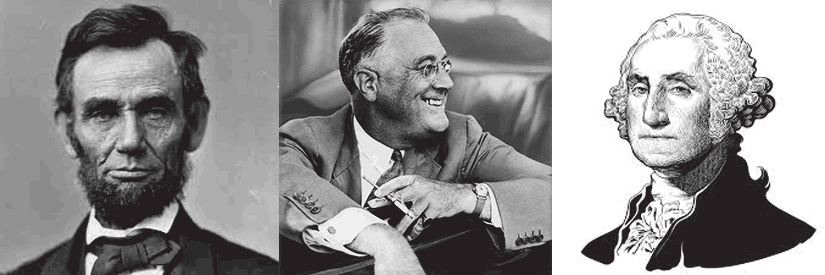
James Fallows has observed that in the beginning even FDR wasn’t FDR. Whoever gets into office has to rely initially on natural skills, most
notably intelligence and the wits of a fast learner, and then gradually apply his own judgment, political instincts and life experience to the job.
Obama unquestionably had intelligence and has proven a quick learner. He’s politically astute if not, in John Boehner's estimation, the world’s shrewdest horse trader. But as for life experience, he didn’t really have much. That was one of the objections opponents raised repeatedly against him in 2008.
In the end, maybe it is possible to overrate the value of life experience. Nobody had a finer-looking resume than Herbert Hoover. But perhaps no amount of experience could counterbalance the gravity, and the depth, of the economic catastrophe he faced. One thing FDR took office knowing was to throw conventional wisdom out the window because nothing Hoover tried wound up working.
Quotable
Poor Ike. He's used to being a general. He's going to come into the White House, and he'll order people to do this and do that, and nothing will happen
Truman on Eisenhower, 1952
How might President Romney deploy his intellect, problem-solving abilities, investment acumen and management skills against the challenges of his new role, a job most experts agree nothing can really prepare you for? Well, a man’s got to start somewhere.
One of the things he might conclude—once he got his sea legs under him and could focus on things through his own lens rather than that of the horde of pecking ducks that comprised his advisers—is that the break-up value of the country was higher than its market valuation.
His instincts might tell him what was called for was a massive asset selloff to raise sorely needed cash and a balance-sheet reorganization. He could sell off half the states along with their assets and their populations. Then he could buy back the existing domestic debt, pool it with the cash raised and swap it all into equity, which could then be distributed to the remaining population in the form of equity participation shares.
This distribution would, of course, be in lieu of any further government obligations in the way of Social Security, income security, welfare payments or Medicare. That would go a long way towards balancing spending and revenues, at least in the short term.
He could then just outsource basic government obligations to willing third-party providers in order to cut down on the costs of federal infrastructure. For instance, defense and national security could be sub-contracted to the government of Iran, thereby solving two intractable problems in one brilliant stroke. Any aggression on Ahmadinejad’s part would prove disastrous to his nation’s new business model. The two countries’ national interests would be perfectly aligned. Kissinger would be so proud.
With any luck, the asset/debt equation after the asset sales swaps and balance sheet right-sizing would come out pretty much to a wash, thereby eliminating most of the national debt, although it would shift a tad toward the negative after declaring the inevitable LBO performance bonus for himself and a select group of senior advisers, as a reward for the scope of their financial reengineering services. That of course would have to be financed, at least at first.
With all that in place, President Romney could, picking the appropriate moment, announce to the nation that, his work done, he would not serve out his full term but would instead be retiring with family and several key administration members to the Cayman Islands.
In return for safe passage, he would promise that none of his descendants would ever run for US President. Not that they’d have to, with the payout he’d negotiated for himself and his progeny. Or for that matter would even seek to be allowed back into the United States.
The five-year survival prospects for the leaner, meaner, reconfigured, reorganized country? Probably 50-50. Not much better than the track record of Romney's early LBOs at Bain Capital. After all, no man can be expected to be a total genius in such a difficult situation right out of the box. It would take a little sacrifice from the rest of us to make it all work.
And what good would genius be in a President anyway? The two Presidents acknowledged to possess the most smarts in modern times were, by almost all accounts, Jimmy Carter and Richard Nixon. What good did it do them?
Presidential Occupations
What they did when they weren't being President
lawyer
59%
Vice President
32%
governor
32%
military
27%
private sector
21%
farmer/ rancher
20%
congressman
20%
teacher
18%
finance
18%
writer
16%
senator
14%
other govt positions
9%
land surveyor
7%
college president
7%
minister
2%
Figures add up to more than 100% because Presidents are shameless multi-taskers
3/11/12 -- Shudda, Cudda, Wudda
Rush Limbaugh’s meltdown over Sandra Fluke’s contraceptives testimony was orchestrated by a White House conspiracy, opines Bill O’Reilly. It was “manufactured to divert attention away from the Obama administration’s disastrous decision to force Catholic non-profit organizations to provide insurance coverage for birth control,” he charged.
Thus keeping his perfect record intact. The preposterousness of such a notion was encapsulated neatly in a posting on the website News Corpse .
Somehow the President’s strategists concocted a plot wherein an unknown law student would manage to manipulate the Republican chairman of a congressional committee to refuse to let her participate, and then she would trick the country’s top radio talk show host into verbally assaulting her. What could be simpler?
Darrell Issa (R-CA.) is chairman of the House Oversight and Government Reform Committee. Officially it has legislative jurisdiction over the District of Columbia, the government procurement process, federal personnel systems, the Postal Service and other matters. In practice, the committee has evolved into congress’s investigative arm for looking into virtually anything it wants. Its chairman is the only one in congress with direct subpoena powers. Between 1997 and 2002, it issued 1,052 subpoenas to probe alleged misconduct by the Clinton Administration and the Democratic Party, at a cost of more than $35 million.
When Issa became chairman, following the 2010 congressional elections, he promised to launch scads of investigations to ferret out executive branch waste abuse and fraud, calling the Obama White House the most corrupt in history. So far his committee has held hundreds of hearings and made more than 700 requests for information but issued fewer than two dozen subpoenas. Moreover, The Washington Post has reported that many of the efforts resulted in no follow-ups, hearings or reports.
It would seem like an improbable role for a man whose personal record includes multiple and variegated brushes with truth, ethics and the law (on his way to becoming the sixth richest member of congress). Ah, the ironies of life. (As a congressman now for 11 years, Issa might brush aside such a slur on his past by invoking Big Julie from Chicago, who thusly defends his own wayward youth in Guys and Dolls: “ever since then I have gone straight, as I can prove by my record — 33 arrests and no convictions.” Actually, Issa has one conviction.)
In fairness to Issa, his most recent hearings were never intended to examine the appropriateness of women getting access to contraceptives as part of health care coverage. Rather, he wanted to explore whether the executive branch was impinging on the religious freedom of those who make health care decisions at religious-affiliated hospitals, universities and the like.
If anyone questions that, they need only refer to the title of the hearings: "Lines Crossed: Separation of Church and State. Has the Obama administration trampled on Freedom of Religion and Freedom of Conscience?"
Issa allotted minority committee members only one witness; he rejected Fluke, however, because she was not a member of the clergy. He also faulted Democrats for not submitting her name in time for proper vetting. He received the request on Feb. 8 for a Feb. 10 hearing.
Subsequently, Fluke gave her testimony at a special, unofficial hearing convened by House Democrats. The rest is history, thanks in large part to Rush Limbaugh’s imprudent, even by his own reckoning, tirades.
Whatever one thinks of Fluke, her bona fides, her comments, what she stands for or even her sex life, there seems to be consensus on both sides of the aisle that Issa probably should have taken the advice of the American Christian pop rock band, Capital Lights, and just Let the Little Lady Talk.
The tables were already tilted pretty well in his party’s favor, and at a full hearing Fluke would have been just another speaker. Does anyone remember a single thing any of the other witnesses said?
No one forced Limbaugh to go off the deep end, and not even O’Reilly could have predicted it, really. But alone in the spotlight and before a sympathetic panel, with no one to cross-examine her basically anecdotal testimony, Fluke did far more damage than she might have. Reporters covering the stacked-deck format at the full hearing were in full-hunt mode for a story, and Rush Limbaugh, in unusually ham-fisted fashion, obliged them.
Limbaugh was just being Limbaugh. (Remember Don Imus?) The Rush Limbaugh show offers up a brand of exaggerated, crudely-framed and often cleverly comic ideological contemptuousness that plays very well with its base audience (about 80% male and mainly conservative). Usually they are the only ones listening.
But with this story and the way Limbaugh handled it, his rants scorched the ears (and eyes!) of a much broader swath of humanity, populated with far more women. What’s funny in the locker room isn’t always funny at the mixer after the big game. Many took offense.
In the wake of his raw, and sustained, tarring (of a non-combatant, so to speak, although some will surely argue) and the somewhat weak-kneed reaction by Republicans, Limbaugh’s show has lost upwards of 40 advertisers (update), and women’s support for the Republican party has plummeted. The Democratic Congressional Campaign Committee has raised more than $1 million with a new "War on Women" campaign, and Obama's reelection campaign has launched a series of "Women's House Parties" to organize female volunteers.
In medieval times, the media elites, when they got done having so much fun with it, would have settled for an epilogue along the lines of “Hoist with their own petard.“ Only it remains to be seen whether this story is even over yet. Might the ill-will linger all the way to the election? Obama at this moment trends ahead of his Republican challengers in polls, and on the generic Congressional ballot, Democrats have now pulled even with Republicans, who had hoped to take over both Houses.
Rush Limbaugh isn’t going away and will probably even get his advertisers back, either the same ones or a whole new flock. But what’s worth pondering is that women comprise more than 50% of the electorate these days.
Women: they’re so touchy. No wonder guys don’t want them in the locker room.
Quotable
Let us, on both sides, lay aside all arrogance. Let us not, on either side, claim that we have already discovered the truth. Let us seek it together as something which is known to neither of us. For then only may we seek it, lovingly and tranquilly, if there be no bold presumption that it is already discovered and possessed
Georgetown President John DeGioia
quoting St. Augustine, in a letter concerning Sandra Fluke's treatment addressed to the Georgetown community
3/1/12 -- No Words; Just Music
(right-click for controls)
Well, a few words. (You may as well ask Roger Rabbit to resist Shave and a Haircut.)
This video clip features Floyd Cramer (Mr. Piano) and Chet Atkins (Mr. Guitar) in 1965, possibly on the Jimmy Dean Show. On his show Dean made a sustained effort to give country music headliners mainstream exposure. He also gave Jim Henson his first national media exposure. Rowlf the Dog was a regular on the show.
The lead-off ditty is called On the Rebound, which Cramer wrote and released in 1961, a year after his breakout hit, Last Date. Cramer was by then already a highly sought-after session musician. He originated the “slip note” or bent note piano style, in which two notes are struck almost simultaneously so that one leads smoothly into another. Today it is one of the most identifiable types of riff in country piano playing.
Cramer, who was basically self-taught, once remarked: “Music is emotion, mood, regardless of what you name it. I wouldn’t want to be pigeonholed as playing only country or pop.”
In his heyday, Floyd Cramer backed up just about every headliner who came to Nashville to record, including Elvis Presley, Brenda Lee, Patsy Cline, The Browns, Jim Reeves, Eddy Arnold, Roy Orbison, Don Gibson, and the Everly Brothers. If they couldn’t book him when they wanted, they’d wait.
He played piano on Heartbreak Hotel. You gotta listen; but if you do, his contribution to framing the song is unmistakable, the way Sinatra’s “saloon song” piano player, Bill Miller, used to do for Ole Blue Eyes.
Cramer was a musician, not a singer. He wrote Last Date as an instrumental. It peaked at number one on the country chart and at number two on the Hot 100. It was an international hit as well.
And it had legs. Skeeter Davis (The End of the World) recorded it in 1990 with lyrics she and Boudleaux Bryant wrote. Their version was called My Last Date (With You), and it, too, was a top-30 pop and top-five country hit.
Also in 1960, the Davis lyric version was released as a single by Joni James and as an album track by several artists including Ann-Margret and Pat Boone.
In the mid-1960s, Lawrence Welk recorded an instrumental version of the song; the piano-dominated arrangement stuck very closely to Cramer's original version.
In 1972, Conway Twitty recorded the song with new lyrics he'd written. It was called (Lost Her Love) On Our Last Date and was his seventh solo number-one on the U.S. country chart. It spent one week at number one and a total of 13 weeks on the chart.
In 1982, Emmylou Harris recorded the Conway Twitty version as (Lost His Love) On Our Last Date which became her fifth number one on the country chart as a solo artist.
In 1987, R.E.M. recorded the Skeeter Davis version for the B-side of their single It's the End of the World as We Know It (And I Feel Fine).
Deborah Harry covered My Last Date on her solo album, Debravation, released in 1993. Her styling of the song, to some, out-Skeetered Skeeter Davis in its plaintive quality. But you can be the judge.
Ah 1960, when everything was still in front of us. Including things like warnings on cigarette packs. A lifelong smoker, Cramer died of lung cancer in 1997 at the age of 64. Too soon.
Okay, he wasn’t a rock legend, but Davy Jones (died Feb.29 at age 66) had an enduring charm. And Daydream Believer ('67) was a better pop song than many. (The Monkeys’ last #1 U.S. hit, it was written by John Stewart who replaced Dave Guard in The Kingston Trio when the latter left to seek purer art. Could Stewart have made a better statement on his own feelings toward the genre?) An actor from an early age, Davy Jones played the Artful Dodger in the stage show Oliver and got nominated for a Tony. He appeared with the Broadway cast on Ed Sullivan the same night The Beatles made their first appearance on the show. Jones said of that night, "I watched the Beatles from the side of the stage, I saw the girls going crazy, and I said to myself, this is it, I want a piece of that." Well done, Davy. You got pretty close.